

Sommaire
TMS (Transport Management System) software plays a key role in helping transport companies optimize their business and boost their competitiveness.
But with an ever-growing range of TMS solutions on offer, often with very similar promises, how do you choose the best tool for your company and your transport business? Which software will really enable you to manage your flows more efficiently, save time, automate processes, reduce costs and improve the management of your business?
What opinions and feedback can guide you in your selection?
In this article, we present a TMS comparison based on an analysis of 5 leading market solutions: Sinari TMS Ready, Dashdoc, Akanea XROAD First, LIS WinSped and Teliae Teliway.
You'll find the best features of each solution, their key benefits, and possible alternatives to suit your context.
This top 5 list is based on a number of concrete criteria:
-
functional richness adapted to road haulage
-
ergonomics and ease of adoption,
-
ability to integrate with your IS ecosystem,
-
feedback from carriers using these solutions.
🚛 Whether you're an SME transport manager, operations manager, or in charge of your company's digital transformation, this TMS comparison will help you make the best choice in 2025.
Ready to discover the solutions that will truly transform your transport management?
Sinari TMS Ready: the all-in-one suite for managing all your transport activities
Sinari TMS Ready has established itself today as one of the most comprehensive solutions on the market to support carriers in managing their operations, whatever their size or business.
Designed in SaaS mode, this transport TMS facilitates deployment and rapid adoption by teams, while offering a very broad functional scope.
Its aim is to centralize and digitize all the carrier's business processes, from order taking to invoicing, including operations, activity monitoring and driver social management.
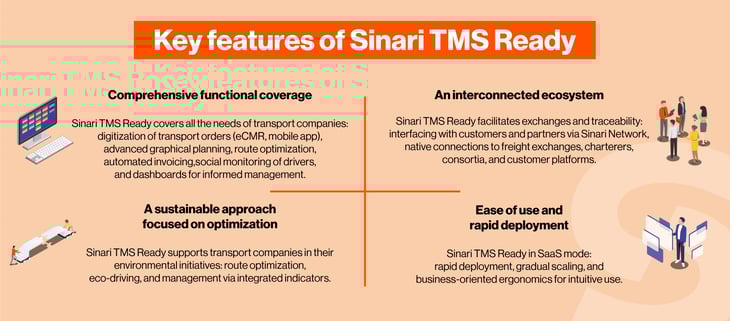
In short, Sinari TMS Ready is the ideal solution for :
-
Carriers looking for a complete, scalable TMS.
-
Companies wishing to centralize all their transport processes on a single platform.
-
Structures aiming for advanced digitalization and strong interconnection with their ecosystem.
👉 By opting for Sinari TMS Ready, carriers gain a real performance lever, combining cost control, productivity gains, enhanced customer satisfaction and improved service quality.
Its competitive price in SaaS mode also optimizes the cost/value-added ratio for the company.
Dashdoc: a collaborative, mobile TMS to simplify transport operations
Dashdoc is a SaaS-based TMS that has won over many transport companies, notably thanks to its intuitive, mobile approach.
Designed to meet the operational needs of operators and drivers, the software focuses on ease of use and fluid exchanges.
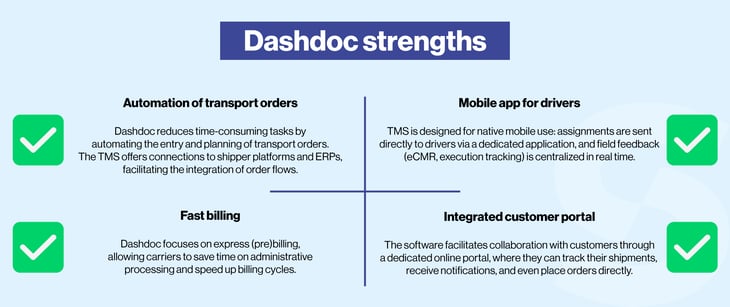
In short, Dashdoc is a solution appreciated for :
-
Its ease of deployment in SaaS mode.
-
Its collaborative approach (customers and drivers).
-
Its focus on speed of execution and reduction of low value-added tasks.
A good choice for your TMS comparison, especially if you're looking for a mobile tool that's quick to learn.
Akanea XROAD First: a scalable TMS designed for road transport SMEs
Akanea XROAD First is a TMS software designed specifically for SMEs in the road haulage sector. It is based on a modular, scalable and interconnected approach, with a wide range of functions adapted to different types of transport (batch, half-batch, bulk, tipper, etc.).
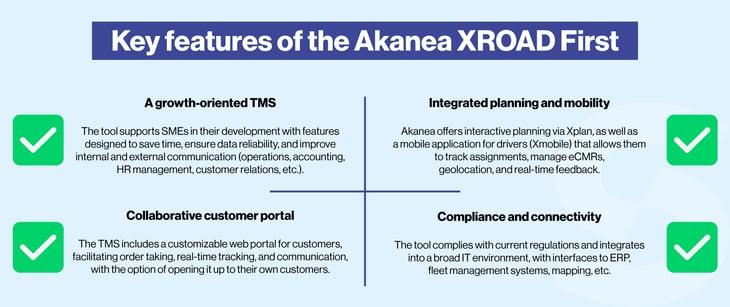
In short, Akanea XROAD First is the TMS for small and medium-sized transport companies looking for a :
-
Structured yet scalable,
-
With advanced planning and mobility tools,
-
And a good balance between business functionality and ease of use.
A strong candidate to consider in your SMB TMS comparison.
LIS WinSped: a modular, robust TMS for customized transport management
WinSped, developed by LIS, is a modular TMS designed to meet the complex needs of transport and logistics companies.
It stands out for its ability to adapt to specific business processes, thanks to a highly configurable architecture.
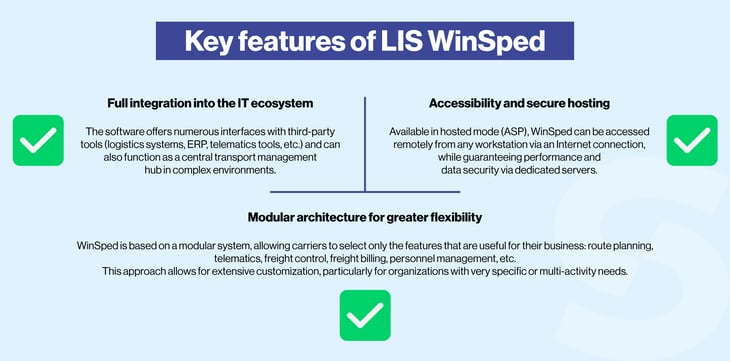
In short, LIS WinSped is a solution particularly well suited to carriers:
-
With highly specific or complex requirements,
-
Looking for a customizable, modular TMS,
-
Wanting seamless integration with their existing systems.
To be studied closely in a TMS comparison focused on customized needs.
Teliae Teliway: a TMS specialized in courier and express services
Teliae Teliway is a TMS particularly well established in the courier and express sectors, with a clear positioning: optimize management of the first and last mile.
The software is designed to meet the demands for responsiveness, traceability and real-time tracking specific to these businesses.
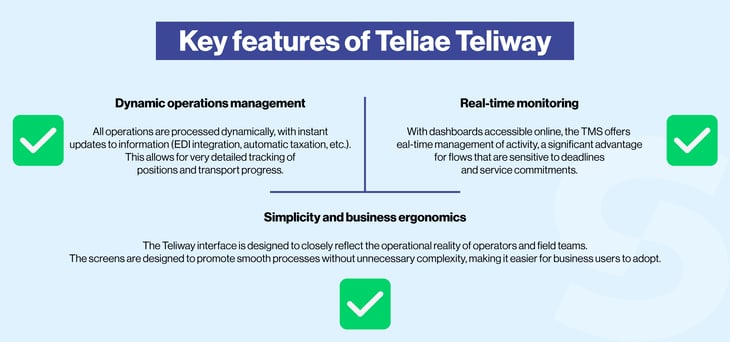
In short, Teliae Teliway is an ideal solution for carriers:
-
Specialized in courier, express and last-mile management,
-
Looking for a simple, responsive, business-oriented solution,
-
who want fast processing and real-time management of their business.
A must for your TMS comparison, especially if you're in the courier or express business.
How to choose your transport TMS? Our key tips
With so many different products on the market, choosing the right TMS software is not just a matter of comparing lists of features. It's about finding the solution best suited to your business, your organization and your priorities in the field. Here are the main criteria to be taken into account in any good TMS comparison:
Identify your specific business needs
Every transport company is different. Before taking the plunge, ask yourself the right questions:
-
Do you handle full truckload, courier, charter, bulk, etc.?
-
Do you have specific requirements in terms of drivers, social regulations, invoicing?
-
Do you need to centralize several agencies or activities in a single tool?
A good TMS should be able to adapt to your actual processes, not the other way around.
Check functional coverage
A high-performance TMS must cover all stages of the transport chain:
-
order taking, planning, chartering,
-
execution, traceability, field feedback (via mobile or eCMR),
-
invoicing, analysis, reporting, connectors.
The wider the scope, the fewer third-party tools you'll need (and the fewer duplications and losses of information you'll experience), improving customer satisfaction and overall ROI.
Think integration and interoperability
Your TMS shouldn't operate in silos. It must interface easily with :
-
your internal tools (ERP, payroll, accounting, CMMS, etc.),
-
your partners (customers, charterers, groups),
-
your field tools (telematics, navigation, customer portal, etc.).
A well-connected TMS saves you time and improves the quality of exchanges, while giving you a competitive edge.
Evaluate ergonomics and ease of use
A good TMS must be intuitive for operators, drivers and administrative teams alike. Tools that are too complex or rigid risk slowing down internal adoption. Good ergonomics = faster tangible gains and better adoption by teams.
Quality support and effective user assistance are also essential to guarantee project success.
Anticipate scalability and support
Choose a solution that can grow with you, without having to change systems in 2 years' time. Choose publishers who can provide you with training, support and business consulting. Software alone is not enough.
Adopt a solution that respects your budget, while allowing gradual deployment according to your business needs.
In short: the right TMS is the one that enables you to simplify, automate and effectively manage your transport activity, while adapting to your operational realities. A well-constructed TMS comparison will help you select the most appropriate solution.
Conclusion
The transport TMS market has never been so dynamic. Solutions are evolving rapidly to meet the sector's new challenges: automation, real-time traceability, environmental optimization, driver social management, integration with the digital transport ecosystem.
Given this wealth of solutions, the choice of a TMS should not be based solely on fashion or reputation, but on your specific business needs, your performance objectives and the tool's ability to support your growth.
A rigorous TMS comparison is the key to making the right choice.
In this comparison, we have highlighted 5 TMS solutions that are among the most representative on the market today. Each has its own strengths and specific features. It's up to you to identify the one that will take your productivity, service quality and profitability to the next level.
.webp)

.webp)


.webp)

.webp)

.webp)