

Summarize this article with:
Sommaire
The logistics labor shortage is no longer a one-off warning. It's a structural challenge that is taking root in French warehouses and transforming the logistics and supply chain professions.
According to France Travail, the transport and logistics sector currently accounts for 1.6 million jobs in France. And yet, needs remain high: almost 195,400 recruitment projects have been identified for 2025, 44.4% of which are deemed difficult due to seasonal peaks in activity. The facts are clear: the sector is recruiting, but companies are struggling to find, train and retain the qualified personnel they need for their operations.
This tension is not confined to road haulage and delivery. It also affects warehouse management, order preparation, loading, shipping, quality control, inventory management and flow planning. At a time when customers are demanding greater responsiveness, more traceability and better quality of service, companies are faced with a simple question: how can they continue to ensure their logistics operations with teams under strain?
Increased recruitment remains a necessity. But this is no longer enough. To cope with the shortage, companies also need to better organize the work available, and be able to recruit less qualified staff. This is precisely where WMS software can become a concrete lever.
The logistics labor shortage: a long-term challenge for companies
A sector under pressure
Logistics is essential to the smooth running of a company. It provides the link between procurement, production, storage, transport, shipping and final delivery to the customer. Without reliable organization, the entire supply chain becomes fragile.
The transport and logistics sector is one of France's leading industrial employers, with hundreds of thousands of employees throughout the country. Yet job vacancies remain largely unfilled, and recruitment times are getting longer every year. The rise of e-commerce, the intensification of last-mile logistics and the growing demands of the supply chain have multiplied the need for operational personnel, without the pool of candidates keeping pace.
Turnover, qualifications, training: the triple problem
The ability to provide feedback in real time is one of the strong points of on-board IT for training your drivers in eco-driving. Once the best practices have been defined in the telematics tool, drivers are immediately alerted if they fail to respect the principles imposed by eco-driving, enabling them to self-correct in complete autonomy. This is an undeniable asset for really anchoring new driving methods in the minds of drivers, without it being too restrictive for them.
In many warehouses, the shortage of manpower manifests itself first and foremost in high staff turnover. New employees arrive, are trained, get their bearings... and then sometimes leave after a few weeks or months. As a result, the recruitment cycle starts all over again.
Each departure costs time, money and energy. You have to publish a vacancy, look for a candidate, organize the hiring, provide training, support the development of skills, and then correct the errors associated with the learning phase.
Added to this is the difficulty of recruiting qualified workers. An experienced operator knows the locations, storage constraints, preparation rules, customer priorities and team habits. When he leaves the company, some of this knowledge goes with him.
This is a real operational risk. The more the organization depends on a few senior profiles, the more fragile it becomes. Conversely, a company that documents its processes, standardizes its tasks and guides its teams can integrate new employees more easily.
That is the whole point of a WMS: to transform an organization that relies on human memory into a guided, structured, and more flexible logistics platform that is less dependent on business expertise.
The 5 tasks that absorb 60% of your teams' time
Before talking about solutions, we need to name the problem precisely. In the vast majority of warehouses, five categories of operations account for the bulk of the human workload:
1. Order picking: the most time-consuming. More than 60% of a picker's total time is spent on moving around, not to mention searching for products. Every unnecessary return trip, every reference error, every product that can't be found has a major impact on productivity.
2. Receiving goods: an often congested area, making it difficult to check quantity and quality, enter data into the system, and allocate a storage location. A seemingly simple task, but one that quickly becomes a source of errors and slowdowns without a guided process.
3. Storage: a time-consuming stage if the rules are not optimized, to find the right location, avoid duplication, respect storage constraints (FIFO, FEFO, hazardous products...).
Without tools, this relies entirely on the operator's memory and experience, and can have a direct impact on picking and order-picking efficiency.
4. Quality control: manual verification of dispatched quantities, detection of anomalies, re-entries.
An essential step, which can be improved with the right WMS processes.
5. Inventories: a time-consuming task when not digitized or not digitized at all. Part of the team is mobilized, activity is partially halted, and the reliability of counts can still be improved. A dreaded moment, which can become continuous and transparent with a WMS.
Without a suitable tool, these five operations depend entirely on the experience of the operator on the job. With a WMS, they become guided, standardized and optimized, and therefore accessible to a much less experienced profile.
How a WMS transforms the organization in the face of staff shortages
Standardization: fewer errors, less reliance on experienced profiles
This is the fundamental contribution of a WMS in a context of HR tension: it centralizes knowledge of the warehouse in the system, and not in the heads of a few key employees.
When a new operator arrives, he doesn't need to memorize locations, know priority rules or constantly ask a senior colleague. The WMS tells him, step by step, what to do, where to go and in what order. Organizational decisions have already been taken: all he has to do is execute.
The direct result: skills development is accelerated, picking and stowage errors are reduced, and recruitment becomes less risky as it is less dependent on the profile recruited.
Automation of repetitive tasks
A WMS takes care of low value-added decisions which, when added up, represent a considerable mental burden for teams: which location to choose? In what order should orders be prepared? Which picking round is the most efficient?
By relieving the operator of these constant arbitrations, the WMS enables him to work faster, with less cognitive fatigue. It also facilitates team versatility and flexibility: an operator trained on one job can move on to another without a long adaptation period, since it's the system that guides.
In terms of payroll, this opens up real room for maneuver: less dependence on highly experienced profiles, better integration of temporary workers, more flexible planning in times of logistics labor shortage.
Real-time visibility: fewer round trips, optimized routes
One of the most underestimated stress factors in the warehouse is unnecessary movement. An operator looking for a product, turning back, waiting for information: so many wasted minutes which, multiplied by an entire team, represent a significant loss of productivity.
A WMS eliminates this uncertainty. Each operator receives an optimized route: he knows exactly where to go, in what order, for what task. The operations manager, for his part, has a real-time view of the progress of operations, and can reallocate human resources in a few clicks if a priority emerges.
Less needless travel also means less fatigue, fewer accidents, and crews who finish their shift less exhausted, which does not help build loyalty.
Simple interfaces for fast learning
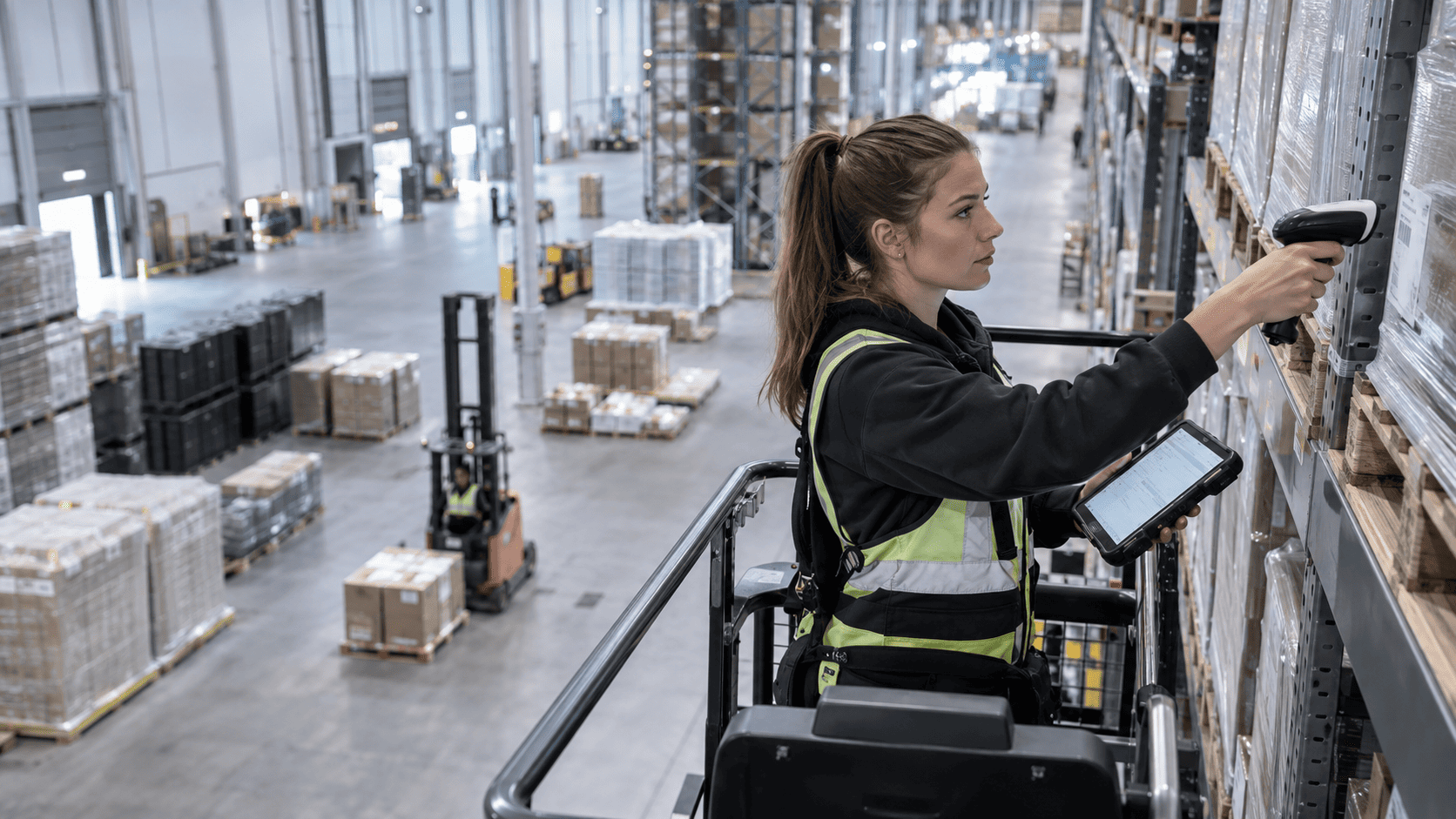
An efficient WMS is not just a tool for experts. Modern interfaces are designed for operators in the field: visual, guided, adapted, accessible from a mobile terminal or handheld. Training takes just a few hours, compared with several days for a complex system.
This ease of use is decisive in a context of shortage. It means you can quickly integrate temporary staff, manage peaks in activity without over-recruiting, and no longer depend on a handful of "essential" employees to keep the warehouse running.
The human impact of a well-deployed WMS: motivation, peace of mind, loyalty
The WMS is often referred to as a productivity tool. And it is. But its effects on human capital are just as real, and often underestimated.
Equipping your teams with a high-performance solution is first and foremost a strong managerial signal: we're investing in their working conditions. We're giving them the means to do their jobs well. This generates recognition, and recognition generates commitment.
Stress reduction is another concrete benefit. When instructions are explicit, when errors are detected before they become incidents, when everyone knows what they have to do and can measure their progress, serenity replaces uncertainty. Employees end their shift with the feeling of having contributed to something that has been mastered.
Physical hardship is also reduced: optimized routes, less unnecessary handling, fewer repetitive, low-value gestures. Operators are repositioned on tasks that require their attention, judgment and responsiveness: all dimensions that enhance their role.
All these factors play a part in building loyalty. An employee who is better equipped, less exhausted, better recognized, is an employee who stays. In a sector where the cost of departure and recruitment can represent several thousand euros, loyalty is as much an economic lever as a human one.
Conclusion
The logistics labor shortage will not be solved by recruitment alone. Of course, companies must continue to attract, train and retain talent. But they must also rethink their organization to make better use of available resources.
A WMS provides a concrete response to this challenge, and can be a real asset for employer branding in attracting new candidates. It helps to standardize tasks, speed up training, reduce errors and wasted time, improve inventory management, optimize travel, monitor operations in real time and enhance customer service quality.
In a market where teams are under strain, demand is changing fast and customer satisfaction depends on reliable operations, warehouse management can no longer rely solely on individual experience, field memory or manual files.
Are you facing these challenges in your warehouse? Find out how Sinari WMS can help you structure your operations, make your inventory more reliable and support your teams on a daily basis.
.webp)

.webp)

.webp)

.webp)
.webp)