
Summarize this article with:
Sommaire
Your trucks are on the road. Your customers are waiting. And you’re juggling phone calls, unexpected issues, and routes that need to be readjusted. Out in the field, one question keeps coming up: Where are my vehicles, and is everything going as planned?
Real-time fleet tracking answers that question. Truck fleet tracking software shows you, in real time, the location of each vehicle and the progress of each route using real-time data. You regain control of your operations without spending your days on the phone.
Here are five concrete benefits for managing and controlling your business.
Why real-time visibility has become essential in transportation
More Demanding Customers and Deadlines
The industry has changed. Your customers are no longer satisfied with just on-time delivery. They want to know where their goods are at all times. This demand for tracking is now a key factor in choosing a provider over the competition. In a supply chain under pressure, visibility into the flow of goods is a key factor in choosing a service provider.
The pressure on delivery times has intensified. An hour lost on a route can throw the rest of the day off track. Without visibility, you only find out about the delay when the customer calls. By then, it’s already too late to respond calmly. You’re left scrambling!
Anticipating operational incidents is becoming a real advantage. A stranded truck, a missed delivery slot, an unplanned empty return trip: every setback comes at a cost. The sooner you spot it, the better you can absorb it.
Responsiveness in route management makes all the difference on a daily basis. You’re no longer flying blind. You make decisions based on what’s actually happening on the road.
This visibility is powered by transport telematics. Behind this term lies a simple idea: a connected device installed in the vehicle continuously transmits its location and usage data to your tracking system. This technology automates data collection. No more manual entry, which means fewer errors and smoother day-to-day management.
What are the advantages of real-time tracking?
The benefits of real-time tracking are concrete and measurable. They can be summarized in five key points: knowing where your trucks are, responding quickly to unforeseen events, keeping your customers better informed, optimizing your fleet, and controlling your costs. We’ll detail each one below.
The common thread is the continuous tracking of your fleet. You no longer rely on memory. You rely on up-to-date data, which enables true monitoring of your operations’ performance.
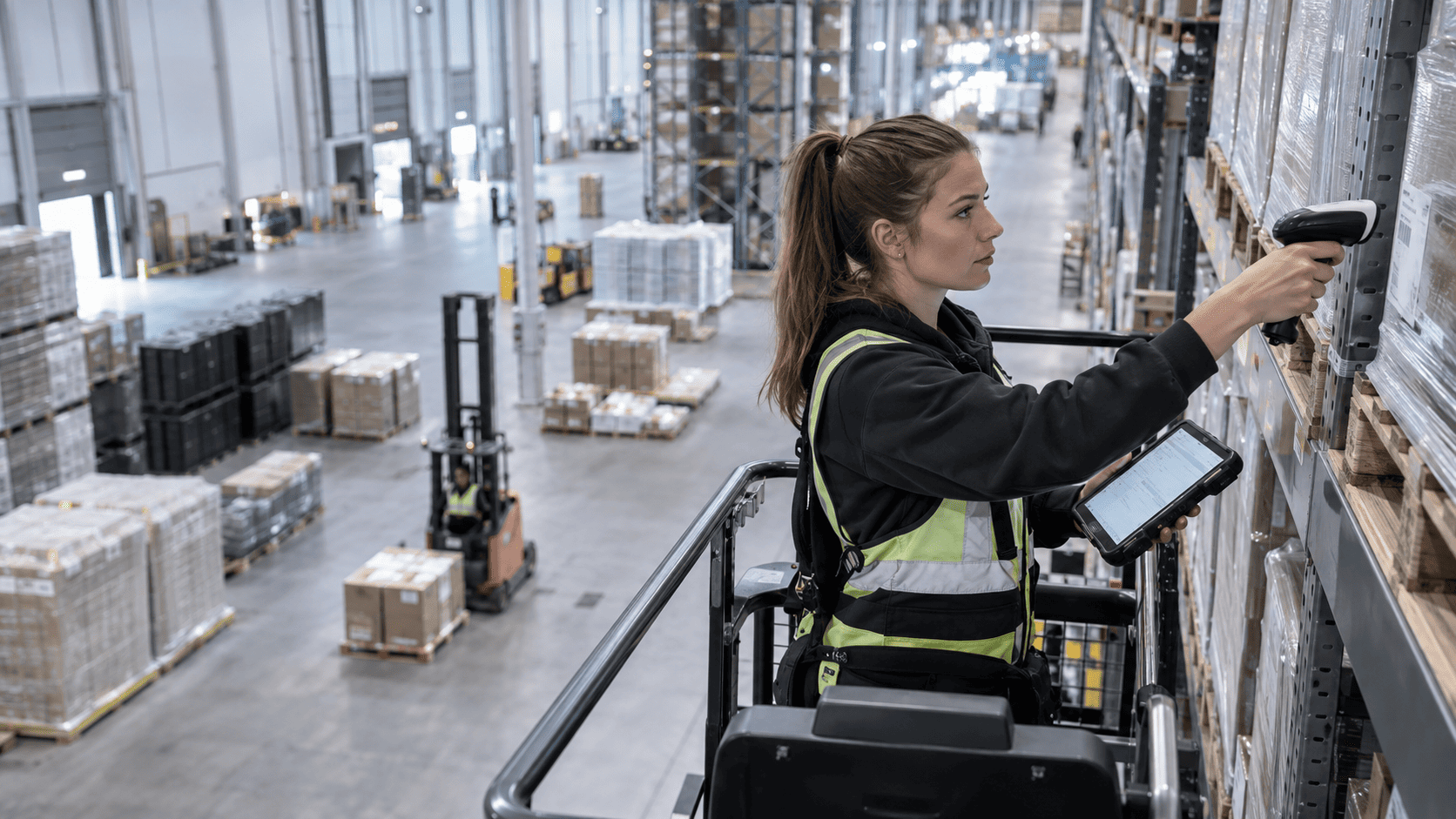
This real-time approach isn’t limited to transportation. It’s also used in warehouses for inventory tracking or production monitoring. This article focuses specifically on your trucks and your profit margins.
Benefit 1: Know where your trucks are at all times
This is the starting point. Real-time heavy-duty truck geolocation displays your entire fleet on a map. At a glance, you can see who’s on the road, who’s making a delivery, and who’s heading back.
You can also track the progress of delivery routes. Has the vehicle left the first delivery point? Is it ahead of or behind schedule? The information is right there—no need to make a call.
This overview helps you quickly spot unusual situations. A truck that’s been stopped for too long, a vehicle straying from its route—you see it right away and can check on it.
This view also enhances safety. A vehicle stopped where it shouldn’t be is spotted immediately. It provides concrete support for theft prevention. Tracking your fleet becomes a simple reflex, not an investigation.
The primary benefit is time savings. The time you used to spend calling your drivers to check in is now freed up to manage your business.
Benefit 2: Respond Faster to the Unexpected
On the road, the unexpected is part of the job. The real question is your ability to react before the situation gets worse.
When a delay occurs, you see it in real time. You notify the customer in advance rather than waiting for them to call you. You stay in control of the relationship.
You can also adjust routes throughout the day. An urgent order comes in? You identify the nearest vehicle and assign the delivery to it. The re-routing takes just a few minutes.
Communication with drivers becomes clearer. You know where they are before you call them. Your conversations become shorter and more productive. A well-managed unexpected event always costs less than one you’re caught off guard by.
Benefit 3: Improve Communication with Your Customers
Customer satisfaction often comes down to one detail: keeping your delivery promise. Real-time tracking helps you do just that.
You provide precise information on the estimated arrival time. No more vague half-day time windows. Your customer can plan for the delivery, and your relationship becomes more professional.
Delivery tracking also provides reassurance at the final stage. You confirm that the goods have arrived safely, on time, and at the right location. In the event of a dispute, you have a reliable record. This end-to-end traceability protects your customer relationships.
Direct result: fewer tracking calls. Your customers contact you less often because they’re kept informed. Your teams can focus on operations instead of answering the phone all day. This time saved translates into the ability to handle more delivery routes.
Benefit 4: Optimize the Use of Your Fleet
A truck that’s out of service generates no revenue. Yet it continues to incur costs. Real-time tracking helps you better optimize the use of your vehicles.
You can identify underutilized trucks. You can see which ones are idling and which ones could take on an additional run. Route planning is then based on facts, not estimates.
The same data is used to anticipate maintenance needs. A vehicle tracked continuously provides its actual usage data. You can schedule maintenance at the right time and avoid unplanned downtime.
One area deserves special attention: empty-run miles. A vehicle returning empty has driven, consumed fuel, and worn down equipment—all without carrying any cargo. Reducing these trips directly improves your fleet’s efficiency. We’ll come back to this later.
Benefit 5: Better Control of Your Operating Costs
This is where real-time visibility impacts your profitability. To manage your costs, you must first measure them—using a dashboard, for example—and real-time tracking provides you with the data to do so.
You track the actual kilometers traveled, vehicle by vehicle. You analyze downtime: waiting times at loading points, breaks, and periods of inactivity. You identify routes that can be optimized.
This data feeds into your transportation operational performance indicators (KPIs), which show you whether you’re moving in the right direction. Empty kilometers, utilization rates, cost per kilometer: these metrics become clear and can be tracked over time.
Fuel alone accounts for more than a quarter of a heavy-duty truck’s operating costs, according to the Comité National Routier (CNR). Every kilometer avoided, every instance of idling reduced, and every optimized route directly impacts your profit margin. These are also concrete arguments you can present to your management to justify the investment.
This allows you to move from a rough cost analysis to cost optimization based on actual data. Fuel consumption, idle time, kilometers traveled: your operating costs are brought under control. This is the foundation for informed decision-making and true operational efficiency.
Frequently Asked Questions
How does real-time monitoring impact costs?
Tracking affects several cost categories at once, and the cumulative effect results in tangible cost savings.
The first area is fuel. By limiting empty-run kilometers and identifying routes to optimize, you reduce fuel consumption, which accounts for more than a quarter of a heavy-duty truck’s operating costs.
The second is avoided losses. Theft prevention protects your vehicles and cargo. An asset recovered quickly means one less total loss.
Above all, you move from estimates to a cost analysis based on actual data. You gain reliable tracking of operating costs and more precise budget management. Your operational costs become transparent—and therefore manageable.
Which metrics should you track to manage your transportation operations?
There’s no need to measure everything. A few well-chosen transportation operational KPIs are enough to stay on track.
Five metrics come up frequently: the empty-run rate, vehicle utilization rate, the percentage of deliveries completed as scheduled, and on-time delivery—which directly impacts customer satisfaction.
The benefit of real-time data is that these metrics are fueled by reliable, automatically collected data. You can track your progress over time without having to re-enter data manually. The right tracking tools make performance monitoring a simple routine.
Does real-time tracking respect drivers’ privacy?
Yes, provided that the framework established by the CNIL and the GDPR is followed. Tracking a company vehicle is legal, but subject to certain regulations.
The CNIL permits geolocation for specific purposes: the safety of vehicles, cargo, and drivers; route optimization; or providing proof of service to a customer. However, it prohibits constant monitoring, such as continuous speed monitoring for the sole purpose of issuing fines, which is deemed disproportionate.
Three rules govern implementation: Inform each driver in writing and consult with employee representatives before deployment. Allow tracking to be deactivated outside of working hours when the vehicle is also used for personal purposes. Limit data retention: two months in principle, up to one year for route optimization. The system must also be listed in the data processing register.
Transparency is not just an obligation. It is the best way to gain buy-in. Tracking that is clearly explained—and focused on safety and organizational efficiency rather than on monitoring individuals—reassures teams and protects the confidentiality of employee data.
Is real-time monitoring easy to set up?
This is often the first concern of an operations manager: a tool that requires weeks of configuration and training. Today’s connected solutions have changed the game.
The technical requirements are minimal. A device communicates with an app accessible from a computer or phone. No server to install, no technical work required. Your data starts flowing as soon as you get started.
True success depends above all on people. Introduce the tool to your drivers, explain its purpose, and involve employee representatives early on. A shared project is an accepted project.
In terms of time, a properly scaled solution can be up and running in just a few days.
Conclusion
Real-time tracking is more than just a dot on a map. It gives you five concrete advantages: knowing where your trucks are, reacting quickly to the unexpected, communicating better with your customers, optimizing your fleet, and controlling your costs.
These five benefits all converge on a single point: visibility allows you to steer your business rather than be at its mercy. You adopt a proactive approach. You make decisions based on facts, not estimates.
To take it a step further, an onboard IT solution for heavy-duty trucks combines these functions into a single tool, directly connected to your vehicles. That’s what Sinari Telematics offers—designed for operators who want to be at the heart of their operations.
.webp)

.webp)
.webp)
.webp)
.webp)
.webp)