
Summarize this article with:
Sommaire
A refrigerated truck that runs half-empty costs twice as much: once in fuel, and once in lost opportunities to carry more cargo. For an operations manager, the real question isn’t “Should we use a dual-temperature or triple-temperature vehicle?” but “How can multi-compartment loading plans and route optimization reduce empty-run mileage without complicating each route?” The ATP standard regulates heavy-duty truck equipment (sensors, insulated partitions, refrigeration units) but says nothing about the actual load factor achieved compartment by compartment. This is where companies like STEF and Pomona—leaders in temperature-controlled transport in France— and TMS software providers for refrigerated transport set themselves apart: through their ability to increase the load factor using planning that takes into account both the vehicle and its adjustable-size compartments, depending on the volumes and temperatures to be transported. The FNTR and ADEME regularly highlight the significant impact of refrigerated road transport on the sector’s costs, fuel consumption, and emissions—yet another reason to treat the loading plan as an asset, not a constraint.
The multi-compartment loading plan: a powerful tool for reducing empty-run miles
The multi-compartment loading plan is often viewed as a technical constraint, when in fact it is the primary source of profitability for a refrigerated delivery route. A three-temperature truck that departs with a frozen compartment 90% full and a chilled compartment 40% full is not optimized: it is traveling half-empty in terms of its usable volume, without either the driver or the dispatcher having a clear understanding of this imbalance at the time of departure. The cause is almost always the same: thermal incompatibilities that were not properly anticipated in advance, forcing the separation of orders that could have been transported together if the volume allocation and compartment sizes had been adapted to the orders being shipped.
The challenge is to plan both the vehicle’s loading and its compartmentalization together: the size of the temperature-controlled zones can be adjusted in increments based on available equipment, taking into account the required temperature, volume, weight, and delivery sequence. The fill rate per compartment is the true performance indicator for a multi-temperature route, according to feedback from carriers such as STEF. In practical terms, for an operations manager, this changes the nature of route planning: the goal is to identify a coherent distribution of orders and an appropriate positioning of the partitions, based on the data available in the TMS and the vehicle’s constraints—resulting in direct time savings during route preparation and a measurable improvement in overall operational efficiency.
Why do temperature incompatibilities result in trucks running half-empty?
Temperature incompatibilities refer to the physical or regulatory impossibility of storing two products together in the same temperature-controlled compartment—for example, a frozen product at -18°C and a fresh product at +4°C, or food items sensitive to odor transfer. In loading operations, these constraints result in binary exclusion rules: either two orders can share a compartment, or they cannot—with no gray area in between. This is known as multi-temperature compartmentalization: goods must be distributed among different temperature zones and, when the vehicle allows it, the size of these zones must be adjusted according to the orders, while respecting any incompatibilities. The concrete result in the field: a shipment of frozen goods that accounts for only 20% of a compartment’s volume can force the remaining 80% to travel empty, due to the lack of another compatible order available at the time of loading. This explains a large portion of the empty-run kilometers observed on multi-temperature routes—a phenomenon that the FNTR directly attributes to the lack of suitable planning tools in part of the sector.
How does the MCVRP balance costs, food safety, and on-time delivery?
Once compatibility and compartmentalization constraints have been taken into account, the actual route must be organized. The MCVRP (Multi-Compartment Vehicle Routing Problem) is the model used for this: it does more than simply allocate volumes by compartment; it also calculates the most efficient delivery order and route, taking into account travel time and the distance between each delivery point. This model is based on an extension of the VRPTW (Vehicle Routing Problem with Time Windows), incorporating the delivery windows specified by customers as a constraint in their own right, just like thermal compatibility and compartment capacity constraints. In practice, the MCVRP must balance three often-conflicting requirements: minimizing the number of kilometers traveled, meeting delivery schedules, and maintaining the cold chain every time a door is opened—a calculation that only refrigerated transport TMS software can truly perform continuously, route after route, since the number of possible combinations quickly exceeds the capabilities of manual planning.
This is where LIFO (Last In, First Out) scheduling comes into play: by organizing the load so that the orders to be delivered last are loaded first, it limits the number of unnecessary door openings and thus the thermal gradient—the temperature variation that gradually builds up in a compartment at each stop. LIFO scheduling is recognized by best-practice guidelines for temperature-controlled transport as a direct factor in reducing cold chain breaches. Poorly planned scheduling can thus compromise the food safety of a shipment long before any mechanical problem arises.
Are movable partitions worth the investment?
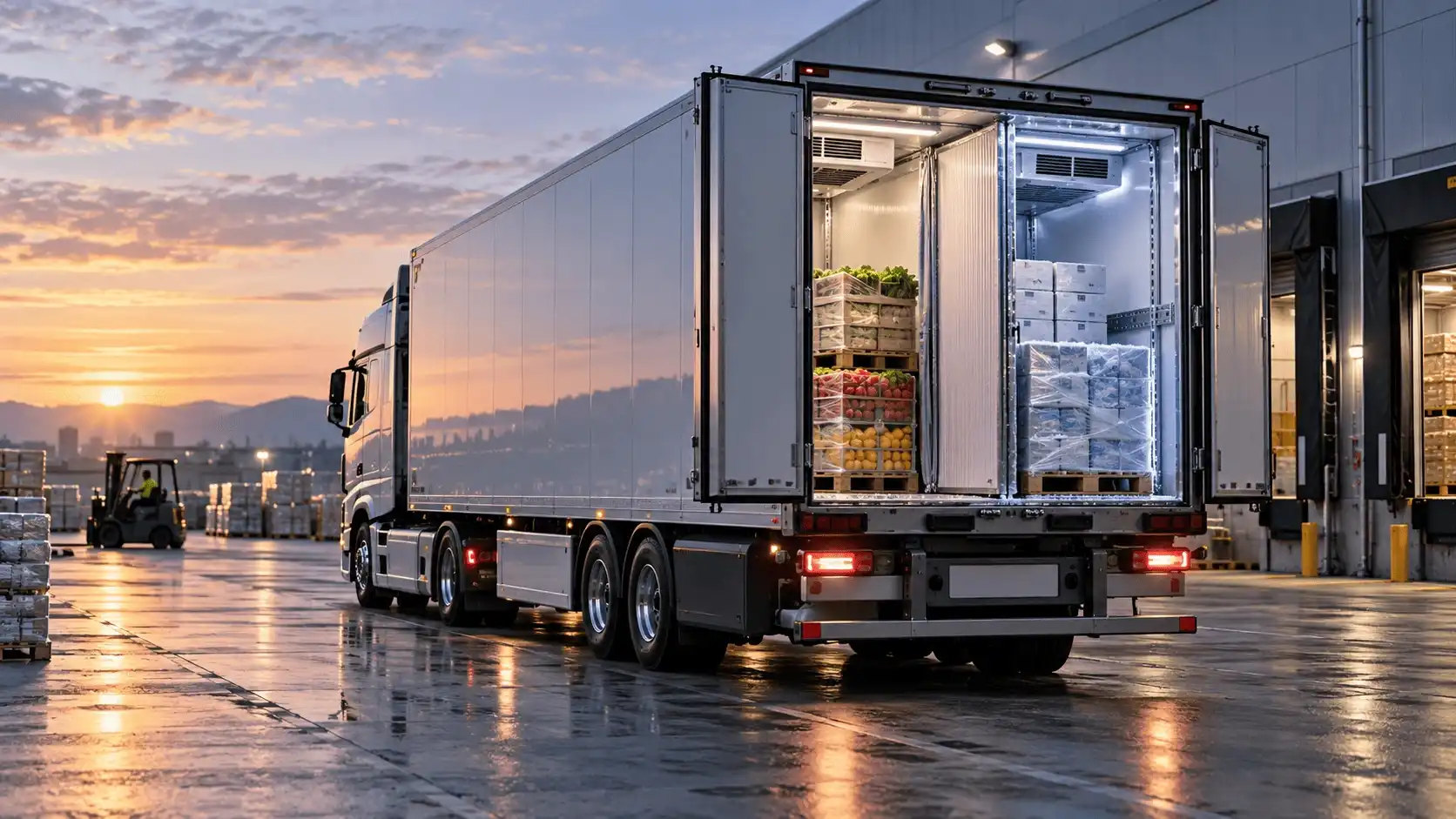
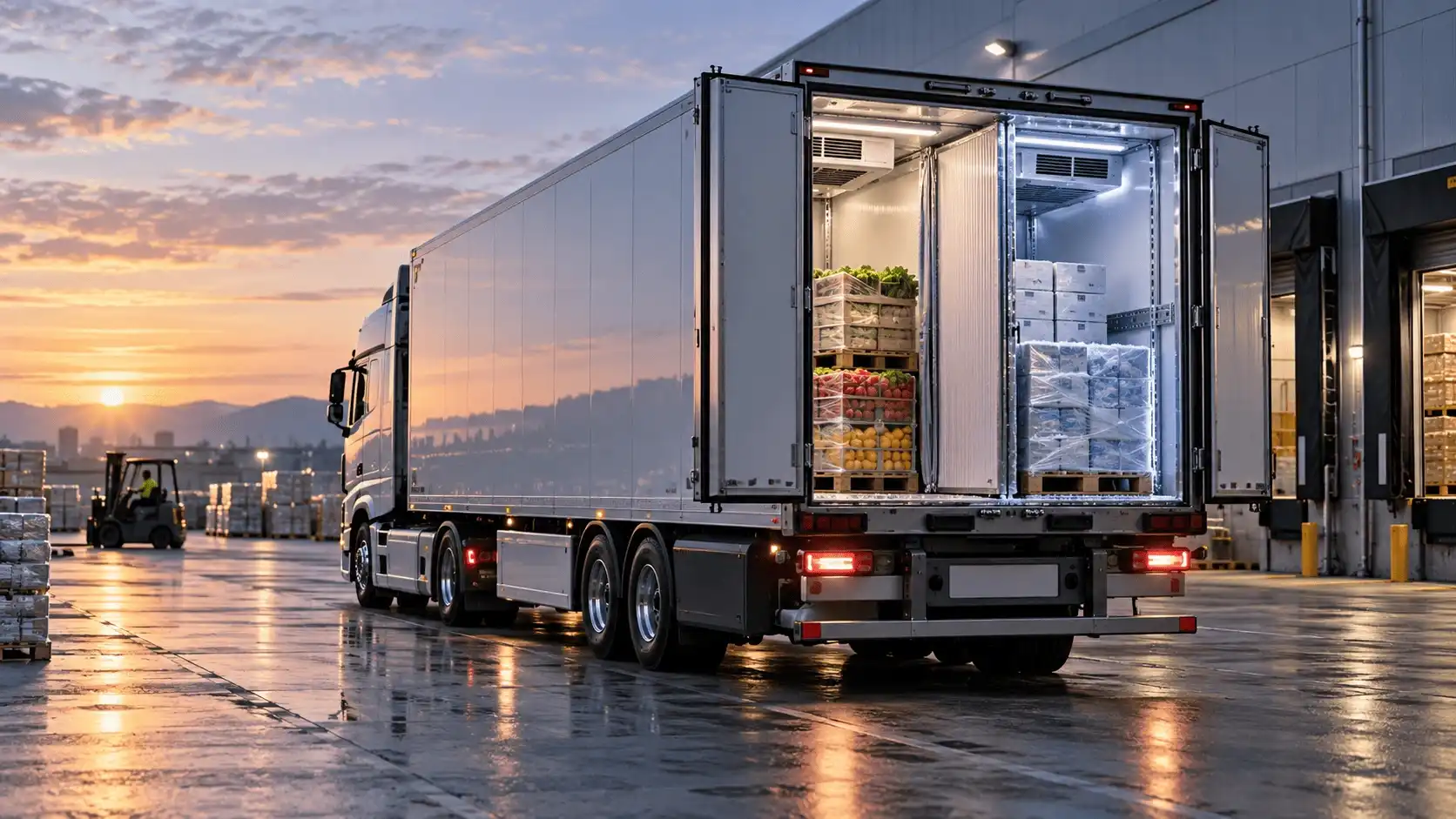
Movable partitions address a problem that the MCVRP cannot solve on its own: the seasonal variation in volumes by temperature range. Compartmentalization that is poorly adapted to daily volumes can leave part of the capacity unused, particularly when the distribution between fresh and frozen goods varies with the seasons. In multi-temperature vehicles, the partitions are generally movable, and their position can be adjusted in increments, within the limits of the onboard equipment. Movable partitions allow the size of each compartment to be adjusted according to the actual volume to be transported: for example, the capacity of a 33-pallet vehicle can be divided into 3 + 30, 6 + 27, or 9 + 24 spaces, subject to the vehicle’s specifications and the space occupied by equipment. This volumetric flexibility is a key factor in fleet reduction for multi-temperature carriers, according to feedback from the temperature-controlled transport sector reported by the FNTR. In practice, a single vehicle can thus handle a large frozen shipment one day and then rebalance its capacity toward chilled cargo the next, without tying up an oversized compartment for occasional use—an efficiency gain that directly translates into a return on investment for fleet management.
Single- vs. Multi-Temperature: When Is a Mixed Fleet Cost-Effective?
Once the multi-compartment loading plan has been optimized, the question of which vehicle to deploy remains, and this is where the decision between single- and multi-temperature vehicles becomes crucial for a fleet manager. Single-temperature or multi-temperature: this question should never be considered outside the actual context of the volumes being handled, yet it is all too often decided based solely on a fleet’s history. A single-temperature vehicle remains less expensive to purchase and easier to maintain, according to cost data typically published by refrigerated truck manufacturers, but it requires increasing the number of trips whenever a customer orders both fresh and frozen goods, requiring two separate runs where a single run would have sufficed with a properly equipped vehicle. The utilization rate per compartment is precisely the metric that allows for an objective decision in this trade-off, an indicator that a refrigerated transport TMS can track automatically route by route, revealing whether a multi-temperature vehicle actually achieves sufficient load in each of its temperature zones, or if one of them is consistently running empty.
The higher purchase cost of a three-temperature vehicle is justified only if the volumes transported and the unloading conditions allow for the effective use of all three temperature zones. When unloading is done exclusively from the rear, access to the cargo can limit the benefits of this configuration, except notably in cases of a full load destined for a single site. A reliable order history, typically derived from the TMS, helps assess this relevance. This is where the profitability of a mixed fleet becomes particularly significant for a fleet manager, according to sector-specific analyses regularly published by the FNTR on the cost structure of refrigerated transport: Combining single-temperature vehicles for dominant routes and multi-temperature vehicles for mixed or irregular routes often results in a better overall load factor than an entirely homogeneous fleet. Proper fleet sizing is therefore not a matter of the dominant vehicle type, but rather of a precise match between the fleet configuration and the actual structure of the orders being processed.
At what utilization rate does a mixed fleet become profitable?
The utilization rate per compartment is the data point that turns fleet planning into a calculation rather than a gamble—provided one knows at what level it actually becomes significant. There is no universal threshold applicable to all carriers, as differences in acquisition costs and order structures vary so widely from one business to another, as the FNTR regularly points out in its sector-specific cost analyses; however, the logic behind calculating the break-even volume remains the same for every operations manager. It involves comparing, over a representative period, the additional purchase and maintenance costs of a multi-temperature vehicle compared to a single-temperature vehicle, and then relating this to the number of trips avoided by pooling temperature zones—a calculation that a refrigerated transport TMS can automate based on actual route history. Once this additional cost is offset by the empty-run kilometers saved over a given period (typically observable in several months’ worth of mixed-load order history), the multi-temperature vehicle becomes the option offering the best return on investment, and the utilization rate per compartment allows you to verify in practice that this threshold has been reached in the field.
When is a mixed fleet not worth it?
A mixed fleet is not a default solution, and making it a systematic reflex amounts to creating the opposite problem: undersized compartments that run empty due to a lack of sufficient volume to fill them. Underutilization of assets is a particular risk for operations with limited temperature diversity, where a single segment (such as fresh goods) accounts for the bulk of orders year-round—an imbalance that can be quickly detected by monitoring the fill rate per compartment via a TMS. In this case, a multi-temperature vehicle ties up capital in compartments that will be used only marginally, without ever reaching the break-even point mentioned earlier. A simple decision-making framework can help avoid this pitfall: it involves cross-referencing the frequency of multi-temperature orders, their volume distribution across temperature zones, and actual load factor history before making any investment. A savvy fleet manager knows that an underutilized multi-temperature vehicle often costs more than a well-sized single-temperature fleet—even if the latter appears less flexible on paper—a finding supported by the real-world experience that ADEME regularly documents regarding the efficiency of refrigerated fleets.
Return trips and pooling: turning empty runs into loaded trips
An optimized loading plan and a properly sized fleet are not always enough to eliminate all empty kilometers: a significant portion occurs on the return trip, which is often treated as a mere formality rather than a source of optimization in its own right. The return trip is the blind spot in most refrigerated transport plans: once the delivery is complete, the vehicle heads back empty, even though this leg of the journey represents a loading opportunity just like the outbound trip. “Backhaul” specifically refers to the practice of identifying and loading freight onto a vehicle’s return trip, rather than letting it travel empty back to its point of origin. In the refrigerated transport sector, this approach often faces a specific challenge: the cargo available on a return trip does not always have the same temperature requirements as the cargo delivered on the outbound leg, which requires verifying that the vehicle, its compartment configuration, and the loading conditions are suitable for handling that cargo.
This is where the pooling of freight flows takes on its full strategic importance: it involves cross-referencing orders from multiple customers or depots in advance to match an available return flow with a compatible request, rather than handling each route in isolation. A refrigerated transport TMS can help match transport requests, loading locations, and vehicle availability. However, the compatibility of temperature zones and the feasibility of the return load must be verified based on the vehicle and the features actually available in the system. The reduction in empty-run kilometers achieved through this type of consolidation often represents the second-largest source of savings after optimizing the load plan itself (with a direct impact on fuel consumption and the fleet’s carbon footprint ) provided that the planning tool is capable of thinking beyond a single route at a time.
What is backhaul as applied to temperature-controlled transport?
Backhaul in temperature-controlled transport faces a challenge that ambient transport does not: available return cargo can only be loaded if it falls within a temperature zone compatible with the vehicle picking it up. Without visibility into all current shipments, a planner simply cannot identify these opportunities in time; this is an information problem before it is a compatibility problem. Multi-client flow visibility is the key to making this practice a reality: it involves centralizing the transportation needs of multiple clients or depots within a single tool to identify potential matches between an empty return trip and a compatible request. A refrigerated transport TMS can facilitate the centralization of shipments and the search for return opportunities, particularly by matching locations and loading windows. Validating temperature compatibility remains a step that must be performed based on available equipment and the tool’s actual capabilities.
Should you charter a refrigerated truck or keep one idle to handle a peak?
One-time chartering or keeping an in-house vehicle idle: this is the trade-off faced by every operations manager dealing with recurring but temporary volume fluctuations, once the loading plan and return flows have already been optimized. An idle refrigerated truck refers precisely to this type of tied-up asset—purchased or leased to cover a period of high activity but which remains underutilized the rest of the year—a fixed cost that weighs on profitability without ever disappearing, even during the off-season.
Temperature-controlled chartering offers a direct alternative to this pitfall: it involves engaging a third-party carrier with the appropriate equipment to temporarily handle a surge in volume, without committing the company to a long-term investment. The annualized cost of owning a company-owned vehicle often exceeds the cost of using charter services on an as-needed basis when the peak period lasts no more than a few weeks a year, according to FNTR analyses of the cost structure of refrigerated transport. However, chartering introduces its own complexities: managing chartered carriers involves selecting carriers capable of maintaining the same level of rigor in the cold chain as the company’s own fleet, and monitoring their performance and customer satisfaction over the long term. A well-configured refrigerated transport TMS allows you to coordinate the use of chartered vehicles just as you would with an in-house vehicle, without disrupting the overall visibility of routes.
In-House Fleet or Refrigerated Chartering: How to Decide?
When choosing between an in-house fleet and refrigerated chartering, the decision should never be limited to immediate costs; it must also take into account the capacity flexibility already available in existing vehicles. A fleet equipped with movable partitions naturally absorbs some of the seasonal fluctuations without relying on a third party, which raises the threshold at which chartering becomes relevant. The decision-making process is based on three interrelated criteria—a multi-criteria approach that a simulator integrated into the TMS helps to objectively evaluate: the frequency of the peak to be covered, the volume flexibility already available internally, and the ability of chartered carrier management to guarantee a service level equivalent to that of the company’s own fleet. A one-time, predictable peak, in a fleet already equipped with movable partitions, is generally handled internally; a recurring but irregular peak—or one that exceeds available flexibility—provides a stronger case for chartering. A refrigerated transport TMS allows these two options to be tracked simultaneously and decisions to be made on a route-by-route basis, rather than locking in a fleet choice for the entire year—a capability for continuous decision-making that specialized software providers highlight as one of the key productivity gains for multi-temperature operators.
The Loading Plan: The Primary Lever Before Investment
The multi-compartment loading plan remains, at the end of this overview, the most accessible and least costly lever for reducing empty-run kilometers, well ahead of any fleet or charter decisions. Whether it involves adapting compartmentalization to temperature incompatibilities, choosing between single- and multi-temperature options, utilizing backhaul, or deciding between an in-house fleet and chartered vehicles, each decision becomes more meaningful when it is based on actual load data rather than on planning habits. A well-configured MCVRP algorithm, integrated into refrigerated transport TMS software, makes it possible to generate this data continuously, trip by trip, rather than reconstructing it after the fact, a capability that both the FNTR and ADEME identify as a key factor in reducing empty-run kilometers, with a positive impact on the environment across the entire sector.
.webp)

.webp)


.webp)

.webp)