
Summarize this article with:
Sommaire
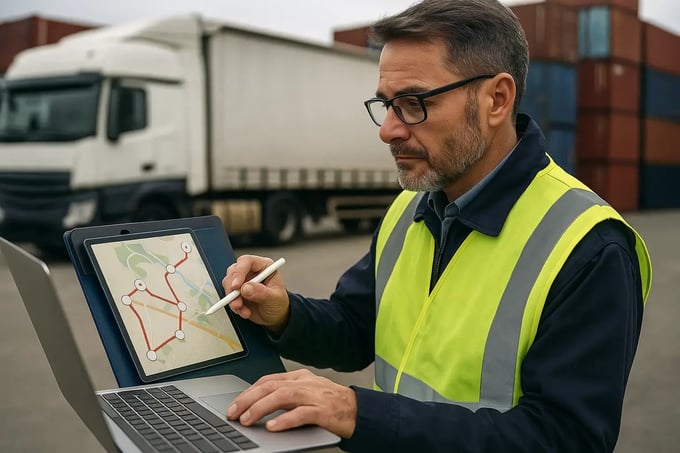
Route planning is the core business for many small and medium-sized road haulage businesses. But between customer constraints, resource management and day-to-day unforeseen events, this task can quickly turn into a headache... especially when it relies on unsuitable tools, such as Excel or home-made solutions.
And yet, today there are simple and accessible planning solutions like Sinari TMS Ready, which can automate a large part of the planning process, while keeping you in control.
The result? Time savings, more reliable delivery routes, better vehicle utilization... and, above all, increased profitability.
In this article, we have a look at the concrete benefits that a well-used TMS can bring to your transport tour planning, and how it can become a strategic ally for your company.
For example, organizing a tour, optimizing a tour, or even better managing planning or travel times, are all levers for small and medium-sized transport companies. In an increasingly constrained environment, control of the supply chain is becoming essential. TMS software helps you achieve this objective, while laying the foundations for strategic planning.
Route planning: a strategic headache for transport SMEs
In a small to medium-sized transport business, every round counts. But between customer demands, last-minute unforeseen events and the management of available resources, dynamic route planning often becomes a time-consuming exercise... and a risky one.
Many operators still rely on tools like Excel, or on personal experience, to organize delivery rounds. As a result, performance relies on a single person, errors accumulate, and the mental load on operations teams soars.
Yet route planning is not just an operational issue. It's a real strategic lever:
- A poorly planned tour is costly: unnecessary kilometres, overtime, redeliveries...
- Poor resource allocation degrades service levels and weakens customer relations.
- Lack of visibility hampers anticipation and responsiveness.
On the other hand, controlled planning enables you to optimize your activity by optimizing rounds, boosting productivity and improving customer satisfaction. But you need the right tools to do this, and that's where the TMS comes in.
How a TMS (really) simplifies route planning
In a small or medium-sized transport business, an operator's day (almost) never starts as planned. New delivery orders, urgent customer requests, an absent driver... It's not easy to build realistic, coherent and profitable routes in this context.
This is where a well-thought-out TMS (Transport Management System) makes all the difference. By directly integrating key operational information, it enables centralized tour planning and management in a simple, reliable and, above all, real environment.
In concrete terms, good optimization and planning software enables you to :
- Visualize at a glance all delivery orders to be assigned, on a clear interface, sometimes coupled with a mobile application;
- Automatically take account of planning criteria (schedules, accessibility, material requirements, etc.);
- Manage available resources (vehicles, drivers, assignments);
- Build realistic routes, reducing manual errors;
- Anticipate delays or conflicts thanks to an alert system and traffic data;
- Generate optimized itineraries for each tour.
Good software also facilitates the use of maps, distance analysis, resource pooling or capacity adjustment according to planning constraints.
Above all, the TMS automates what can be automated, while leaving it up to the operator to manage special cases. No more plans cobbled together in a hurry: transport tour planning becomes structured, fluid and efficient.
👉 Discover Sinari Optim to go further with an optimization engine integrated into your TMS.
Four concrete benefits of route automation
Automating transport tour planning with a TMS gives you a strong competitive edge. Here are four immediate benefits:
Time saved for your operators
By automating the most time-consuming tasks (assigning OTs, taking constraints into account, generating delivery routes), the software frees up a great deal of time each week for your operations teams.
This time can then be reinvested in contingency management, customer relations or continuous business improvement.
More reliable routes, first time
By automatically taking into account customer constraints (schedules, access, type of vehicle required, etc.), the risk of error or omission is considerably reduced.
Optimized routes, relevant assignments, an address delivered on time: the TMS's role is to ensure quality at every stage.
Fewer kilometers, greater profitability
The TMS helps reduce detours, superfluous distances and empty runs, with the key to better cost control.
This translates into fuel savings and reduced environmental impact, while improving the profitability of each tour.
Better use of resources, without overloading
By ensuring efficient organization, a better balance between teams, and optimal capacity utilization, TMS software makes operations more reliable.
The result: more efficient travel and a more balanced distribution of work.
Route optimization: an additional lever to activate
Implementing TMS software to structure, optimize and automate transport tour planning is already a major step forward for small and medium-sized transport companies. But some companies choose to go a step further by integrating additional route planning software.
The software automatically optimizes routes according to your objectives: reducing distances, increasing deliveries, distributing goods... Intelligent algorithms enhance each function, particularly for the collection of multi-site orders or complex constraints.
In concrete terms, an optimization engine connected to your TMS enables you to :
- Generate ideal routes according to your objectives (kilometer reduction, fill rate, priority deliveries, etc.),
- Integrate professional cartographic data, adapted to truck transport,
- Manage complex constraints: multi-temperature, product incompatibilities, ZFE access, precise time slots, etc.
- Simulate different scenarios to compare the performance of your transport plans.
- Respond to a need for greater precision
These are useful features for companies wishing to take the next step in their digital transformation, and now want to continuously optimize their operational performance.
But don't panic: this is not an obligation for all SMEs. The most important thing is to have a solid foundation with an efficient TMS, and to be able to scale up gradually.
Conclusion
Save time, improve day-to-day planning, make better use of resources, cut costs: the benefits of a TMS for transport tour planning are tangible, measurable, and accessible quickly and seamlessly.
For SMEs in the transport sector, it's not a question of revolutionizing their way of working overnight, but of taking a step forward by equipping themselves with a simple, scalable tool designed for their day-to-day needs, for a more sustainable, more profitable and more reliable transport strategy. Well-configured TMS software automates key tasks, while maintaining control over strategic decisions.
And tomorrow, if the company wants to go further, it will be able to rely on complementary building blocks such as route optimization, pro mapping data, or real-time tracking.
👉 At Sinari, we support carriers of all sizes in this approach, with concrete, interconnected TMS solutions tailored to business realities.
.webp)

.webp)

.webp)
.webp)
.webp)
.webp)