
Summarize this article with:
Sommaire
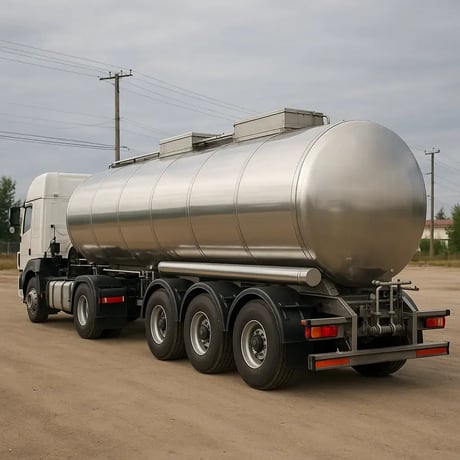
A high-performance route optimization tool must offer you product modeling, packaging, constraints and vehicle resources. These are essential functions for managing routes with tank trucks or compartmentalized trucks.
It's the way you use it within your company that should guide the configuration of the solution, so that it truly reflects your processes and challenges.
Challenges specific to tanker route planning
Planning tanker routes involves much more than simply plotting out a route: it means arbitrating, at each stop, between safety, quality and cost, while maximizing the fill rate. Product compatibility, multi-temperatures, decanting, customer access... These constraints make logistics management and planning complex. This section outlines what any route optimization solution (Sinari Optim, AntsRoute software) must address in order to achieve an optimized organization that can be used in the field.
Seasonal activity and variations in demand must also be taken into account in order to adjust arbitration rules as closely as possible to reality.
Managing quantities for each product and trimming
Organizing rounds with compartmentalized trucks or tankers absolutely requires a good estimate of quantities for each product transported, according to their packaging. This is an essential parameter for guaranteeing tour profitability and avoiding empty miles!
The aim is to achieve optimum distribution by compartment, while respecting capacity limits and delivery times.
For example, your solution will automatically (and manually) allow you to modify quantities by trimming. In this way, you can avoid using a tank for just a few kilos of product, by ensuring that it is completely full.
For the driver, this optimization means fewer hesitations when loading, and smoother operation along the way.
Product incompatibilities and bulk multi-packaging
You'll learn nothing if we remind you that certain products are incompatible and cannot be transported together in the same compartment or tank. Your route optimization tool must therefore be able to deal automatically with loading incompatibilities within the same route (to separate products properly) or on successive routes (to allow for washing in between).
Each transported material imposes its own compatibility and cleaning rules, which must be applied without exception.
The solution must enable several types of packaging to be handled simultaneously in the same goods vehicle. E.g.: Bulk and bag for mills.
On a fleet scale, this flexibility avoids unnecessary downtime and improves vehicle allocation.
Multi-temperature
In the case of tour management using compartmentalized trucks, you may find yourself planning temperature-controlled transport.
In the event of an on-site intervention or a change in customer constraints, planning must be able to be recalculated in a matter of seconds to remain reliable.
And if the goods are not all to be transported at the same temperature, you'll need to be particularly vigilant to ensure that the load lasts.
In order to avoid mistakes and assume the degradation of transported products, your tour optimization engine will be there to guide you in managing the filling of trucks according to the multi-temperature of compartments and the variability of capacities with removable walls.
Trailer transfers
Trailer management, and in particular trailer transfer, is also a key factor in the management of compartmentalized or tank vehicles.
For example, when collecting milk, it may be necessary to drop off a trailer that is too large and poses accessibility problems, so that only the forwarder can be used to get to the various collection points, while gradually filling the trailer dropped off at the location determined on the route.
Once this parameter has been entered into the route optimization engine, you'll be presented with a precise schedule for your drivers to follow in order to guarantee the route and optimize delivery times and trailer utilization.
Customer constraints: from theory to reality
As with all road haulage operations, route planning must be based on "traditional" requirements. Your solution must, for example, enable you to manage vehicle gauges, the need for a screw/blower and many other delivery constraints.
It's also important to estimate operating times according to the type of vehicle, its equipment and the accessibility constraints of the delivery site, to come as close as possible to what will happen in the real world. Here again, a high-performance tool that deals with customers' real needs and challenges can help the planner refine routes.
How do I choose a route optimization software package for tanker trucks?
Start by checking that the software really understands the tanker reality, then look at the day-to-day implementation. A good tool doesn't just optimize a map: it orchestrates transfers and trailer drop-off/hook-up, takes into account operating times (pumping, waiting, access) and gives clear instructions to the driver.
The plan must be executable: order of stops, loading by compartment, washes placed, realistic margins. As for the information system, integration with your TMS/ERP, telematics and temperature probes avoids double data entry and feeds management with field data.
Last but not least, demand explicit objective-based management: safety/compliance first, then product stability, followed by a reduction in empty mileage and operating costs, not forgetting team working time.
With Sinari Optim, you'll be able to integrate all relevant customer constraints associated with your routes, for optimized management of trailer quantities, temperatures, incompatibilities and trailer transfers - whatever the packaging!
.webp)
.webp)

.webp)
.webp)
.webp)