
Summarize this article with:
Sommaire
In road transport, document management remains one of the most sensitive areas: consignment notes, transport orders, proofs of delivery, vehicle documents, invoices... These are all essential elements for controlling an operation, informing the customer or meeting regulatory requirements. But when they still circulate in paper format, they lead to errors, delays and a lack of visibility that hamper operations.
The rise of dematerialized road transport documents is changing all that. By digitizing these key documents and connecting them directly to the tools used on a daily basis, such as a transport TMS capable of centralizing all document flows, carriers reduce the administrative burden, make data more reliable and automate critical stages, from mission preparation to invoicing.
The eCMR, electronic POD or dematerialized invoice are just the first links in a wider system: a continuous, seamless document flow between the field, the operation and the customer. For transport companies, the challenge is no longer simply to digitize documents, but to gain control, responsiveness and operational performance by embarking on a complete digital transformation.
Why road transport documents need to be digitized
Every operation involves an exchange of data between the shipper, the driver, the operation and the customer. Paper documents no longer offer the expected levels of reliability, speed and traceability. A mislaid consignment note, an incomplete transport note or a POD transmitted late can be enough to disrupt a mission, lengthen invoicing times or complicate an inspection. The advantages of digitalization are therefore numerous.
By transforming transport documents into electronic formats, carriers reduce manual handling and have access to more accurate information that can be shared in real time. Data relating to the vehicle, load, goods or delivery are centralized in a single space, limiting discrepancies between the versions circulating in the field and those used by operations. Digitization also has the rebound effect of reducing costs, both financial and time-related.
This evolution also responds to growing pressure: regulatory requirements, customer expectations in terms of visibility, European regulations and anticipation of future controls. In France and abroad, the authorities are increasingly encouraging companies to use dematerialized versions to facilitate checks, ensure road haulage compliance, enable better flow traceability and, quite simply, better document tracking.
For a haulier, the challenges of digitization are much broader than simply replacing paper with a digital format. It's also about ensuring document security at every stage: proving acceptance, tracing goods, limiting disputes, and providing reliable data for day-to-day business management.
Which road transport documents are going paperless, and what does it really mean?
Dematerialization no longer only concerns the consignment note. In road transport, many mandatory documents circulate between drivers, operators, customers and partners. Their transition to digital format is profoundly transforming the way in which the company controls, monitors and secures its operations. Here's a quick rundown of the main electronic documents and how they help optimize processes.
The electronic consignment note
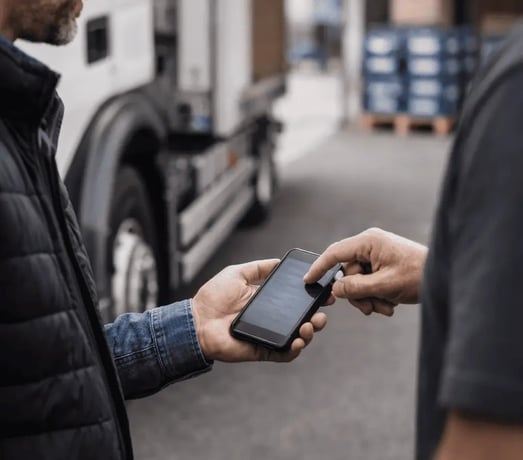
For many years, the paper consignment note was central to the supply chain, and often a source of errors and delays. Its electronic version provides immediate traceability of data relating to the load, the vehicle, the driver and the goods being transported. The eCMR facilitates proof of loading, electronic signature and access to documents for all parties involved in the operation, especially when coupled with on-board computing, which enhances the reliability and speed of information transmission in the field.
POD and proof of delivery
A late delivery or a lost document directly slows down invoicing. The digital POD provides real-time, time-stamped proof of delivery, reducing disputes and speeding up administrative processing. All parties benefit from consistent information, accessible at the end of the trip.
Documents relating to the vehicle or driver
Certificates, authorizations, attestations, regulatory papers: their digital version simplifies checks and reduces discrepancies between the information on board the vehicle and that held by the company. This centralization also facilitates preparation in the event of an audit or inspection.
Electronic invoicing
The transition to electronic invoicing completes the dematerialization of transport. Linked to proofs of delivery and mission documents, it reduces errors and processing times, limits errors and improves financial visibility. It is gradually becoming a standard in France and the European Union.
Transport orders and mission instructions
Often completed by hand or transmitted by e-mail, these essential documents can now be generated automatically from business tools. Drivers receive up-to-date instructions, operations avoid double entries, and customers benefit from more precise follow-up.
From dematerialization to automation: gaining in efficiency, control and responsiveness
A dematerialized document is only the first step. The real gain for a transport company comes when these are integrated into a continuous flow, with no break between the field, operations and administration. It is this connection between business tools that enables better control of operations and automation of low value-added tasks.
When transport data is created directly in the TMS, the consignment note, mission instructions or loading documents automatically include reliable information: addresses, goods transported, delivery conditions, specific constraints. The risk of error is reduced, and each party works on the same version, with simplified document management.
On-board IT plays a key role in the continuity of the flow. The driver receives instructions, validates transport stages, enters any anomalies and transmits proof of delivery without delay. This provides operations with coherent information that can be exploited in real time, facilitating decision-making and the management of unforeseen events.
This progressive automation transforms the way we work:
- teams save time on administrative tasks,
- invoicing can be initiated more quickly,
- customer service quality improves (and confidence grows!),
- the company strengthens its compliance and traceability.
For a carrier, it's a decisive step towards a smoother, more reliable and more responsive organization.
Conclusion
The dematerialization of road transport documents goes far beyond simply replacing paper. By grouping transport documents into a coherent digital ecosystem, carriers gain in reliability, speed and visibility over their entire operations.
Once connected to business tools, these documents become a real lever for automation. Information flows seamlessly between the field, operations and administration, reducing errors, stabilizing processes and speeding up key stages such as invoicing and dispute handling.
For transport companies, this approach represents a concrete opportunity to structure their document flows, reinforce their operational control and offer better service to their customers. The first step towards smoother, more controlled operations... and better prepared for future regulatory changes.

.webp)
.webp)
.webp)

.webp)