What are you looking for?

On-board computing

Drivers: eCMR and in-vehicle for greater simplicity

Posted on 17/12/2025

1 min

Updated on 17/12/2025

Sommaire

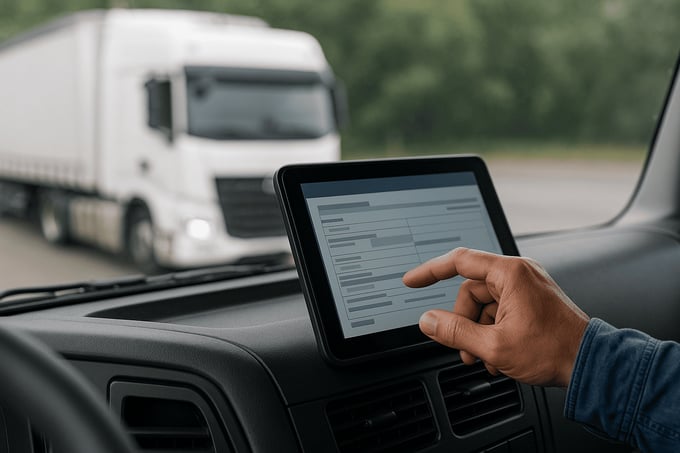
The eCMR is becoming the new standard to replace the traditional paper consignment note. Fully digital, it includes the same information as the paper document but makes it easier to transmit, update, and use. Combined with onboard telematics solutions, it enables drivers and dispatchers to share transport information in real time, without re-entering data or handling physical documents.

This article explains how it works, its legal framework, and the concrete benefits it brings to transport companies and their teams.

Definition of eCMR

The eCMR (for the international version) or electronic consignment note (for the national version) is an electronic consignment note. It contains the same information as the "paper" consignment note, but the eCMR is totally dematerialized (which brings many benefits, as we'll explain later in this article).

For those wondering about its legality, rest assured: it's a totally legal document. The eCMR is in fact authorized:

  • at national level, by the decree of November 9, 1999 on the transport or rental documents to be carried on board road haulage vehicles.
  • internationally, by the additional protocol to the CMR convention concerning the electronic consignment note, added in 2008 and ratified by France in 2016 (for countries that have ratified this protocol).

The many benefits of eCMR for road hauliers

  • Automatic transfer of information from the TMS to the consignment note: with eCMR, there's no need to fill in all the fields, since data is entered almost automatically via your TMS / ERP.
  • Automatic invoicing of the customer upon delivery thanks to electronic signature: once the eCMR has been signed, you receive an alert and a copy of the document, enabling you to start invoicing immediately.
  • Real-time traceability of goods to simplify liability and insurance issues in the event of a dispute: time-stamping and electronic signature ensure true traceability, with real-time tracking at every stage of the transport chain.
  • Enhanced document security: the integrity of the eCMR is guaranteed by the use of electronic signature and time-stamping to prevent document falsification, and by electronic archiving to prevent loss.
  • Reduce ink and paper costs: dematerializing your consignment note avoids printing costs, and therefore saves you money in the long term. It's also a way of limiting waste and thus offering "greener" transport services.

Keeping up with the competition

The TRM sector is going digital: don't let your competitors take customers away from you by offering simpler, paperless solutions for communicating and tracking transported goods.

The use of eCMR has become essential to remain competitive in many markets, so don't hesitate to equip yourself to take advantage of it as soon as possible!

You may also be interested in these articles

Reduce truck maintenance costs

FMS

02/04/2026

Reducing Heavy-Duty Truck Maintenance Costs: 5 Strategies (-30%)

An immobilized truck doesn't just cost a workshop invoice: it costs a derailed schedule, unbilled kilometers, an emergency charter... and sometimes a waiting...

SMART OT

TMS SME

30/03/2026

Automating Shipping Orders: A Guide

Introduction It's 8 o'clock in the morning. In the mailbox of Hervé, operations manager, the first transport orders are already there. A PDF arrived during the...

Truck fleet management

FMS

26/03/2026

Heavy-Duty Truck Fleet Management: A Comprehensive Approach

Managing a fleet of trucks without a structured system means driving blind. As long as the fleet remains limited, a few Excel spreadsheets, paper files and a...

Quarry weighing truck

Quarry

16/03/2026

Traceability of weighing at the quarry: ensuring secure operations and billing

Weighing is at the heart of the quarrying and mining industry: it determines invoicing, engages the operator's responsibility, and feeds into regulatory...

Route optimization

Optimization

05/03/2026

Route optimization: what are the real gains in terms of costs and CO2 emissions?

Introduction Transport costs are constantly on the rise. Fuel, payroll, vehicle maintenance, tolls... Each item weighs more heavily on operating accounts, and...

Euro 6 truck standard

FMS

02/03/2026

Euro 6 standard for heavy-duty vehicles: understanding and managing the regulations

The Euro 6 standard for heavy-duty vehicles is part of everyday road transport life in France and throughout Europe. Introduced to control pollutant emissions...

Workshop vehicles

FMS

25/02/2026

Workshop vehicle downtime: reducing stoppages

A truck at a standstill is never just a repair.

Logistics interoperability

WMS

19/02/2026

Logistics interoperability: supply chain performance and visibility

In the logistics sector, carriers operate in an environment marked by the growing complexity of goods flows, increased pressure on lead times and ever more...

Truck fleet management comparison

FMS

16/02/2026

Heavy truck fleet management comparison: how to choose the right tool in 2026?

In the road transport industry, truck fleet management is rarely a theoretical subject. It's a day-to-day reality in the field, with very real constraints:...

Driver planning

Optimization

11/02/2026

Driver scheduling: better daily decision-making

In a road transport company, planning is no longer limited to managing a schedule day after day. It plays a direct role in organizing transport operations,...

Do you want to make your company more efficient?

Do you want to increase productivity, improve profitability, connect more easily with your clients and partners, gain a global view of your KPIs, and reduce your CO2 emissions through digitalisation?