
Sommaire
In the road haulage industry, the room for manoeuvre is getting smaller every year. Between rising fuel and wage costs, inflation in maintenance costs, pressure from principals, CSR requirements and stricter social regulations, every kilometer must be justified. In this industrial context, energy consumption, equipment service life and the robustness of solutions are becoming decisive criteria.
Operators are also faced with a shortage of drivers and customers demanding precise, real-time tracking. This calls for a reliable IT system capable of continuous operation, whether it's a PC, an on-board computer or an electronic device installed on board the vehicle, powered by electricity and designed for a demanding industrial environment.
On-board computing is no longer a simple geolocation tool. It has become a lever for performance, efficiency and control, provided you choose a product adapted to your needs, budget and existing architecture. Solutions like Sinari Telematics are based on true embedded systems, combining hardware, software, user interface, graphic interface and programming interface, capable of managing connectivity, storage, memory and on-board processor computing power.
This in-vehicle computer comparison is intended as a guide for hauliers, enabling them to compare the characteristics of solutions on the market with their realities in the field. Rather than limiting ourselves to power, version or format, we adopt a resolutely business-oriented approach: improved team efficiency, ability to limit consumption and optimize energy efficiency, concrete benefits for drivers, customers and total cost of ownership.
In the remainder of this article, we review a Top 5 of in-vehicle computing solutions to help you evaluate each option according to your project.
How to choose your in-vehicle computing solution?
Before going into detail about the Top 5, it's essential to remember that embedded computing is not just a question of hardware or components. The right choice depends on your needs, your organization, your available cabin space, but also on your overall software architecture, in particular the TMS model chosen (SaaS or On-Premise), which determines integration, updating and data circulation capabilities.
A solution can be standard or specific, designed for industrial use, integrating a low-power processor, a storage disk, an iot connectivity module, a dedicated connector port, or even an on-board sensor.
Essential criteria
Regulatory compliance (tachograph, CSR)
A good on-board solution enables automated control and processing of social data. Card downloading, secure archiving, compliance with legal obligations: these are all functions required to ensure compliance, without adding to daily tasks.
Driver to operator communication
Modern solutions feature a clear user interface, designed for use in the field. Messaging, documents, missions - everything needs to work simply, wirelessly, with a constant presence of useful information.
TMS / prepayment / maintenance integration
The real advantage lies in the architecture of the embedded system. A standard, open solution enables better data conversion between tools, facilitates the assembly of workflows and reduces production errors.
Real-time monitoring
Location, alerts, mission status: data processing must be immediate, continuously fed, with sufficient computing power to execute each task without latency.
Costs (installation, subscription, hardware)
The budget is not limited to the price of the product. You need to take into account the total cost, installation and assembly, the lifespan of the equipment, and the resources required to operate it.
Assistance and support
A good supplier provides expertise, testing, ongoing development and human contact, particularly during the set-up and conversion phases.
Ergonomics for drivers
A clear design, an easy-to-read graphical interface and well-thought-out functionality are essential to ensure acceptance in the field.
This comparison will help you make sense of your priorities.
TOP 5 best in-vehicle computing solutions
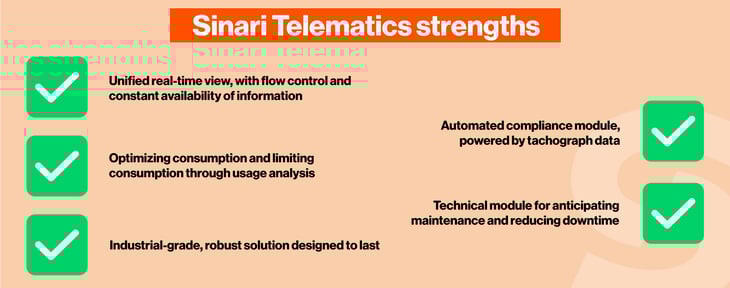
Sinari Telematics: the connected solution for transporters
Sinari Telematics is a solution designed to meet the realities of the transportation industry. It is based on a robust architecture, capable of continuous operation even under demanding electrical and environmental conditions.
The solution centralizes vehicle, driver and mission data in a coherent unit, automatically fed by field data flows. It is based on standard and specific modules, natively integrated with the TMS and social management tools.
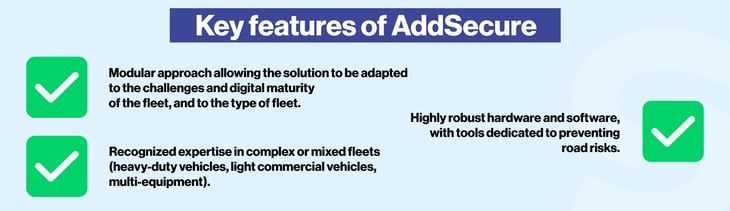
AddSecure: comprehensive, modular telematics with a strong focus on safety
AddSecure is one of Europe's long-standing players in the field of on-board computing. AddSecure offers a standard solution designed for complex industrial environments, with a strong focus on security and control.
The solution is particularly well-suited to hauliers looking for a high level of reliability and extensive functional coverage, particularly in terms of risk prevention and monitoring driving behavior.
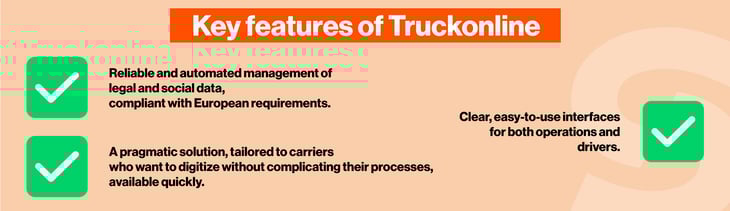
Truckonline: the business solution for compliance and simplicity
Truckonline favors a standard, operational needs-oriented approach, with rapid use and simplified implementation.
The platform provides a clear view of key information, without excessive complexity, making it a solution appreciated by teams in the field.
Trimble: the specialist in advanced tracking & routing for the supply chain
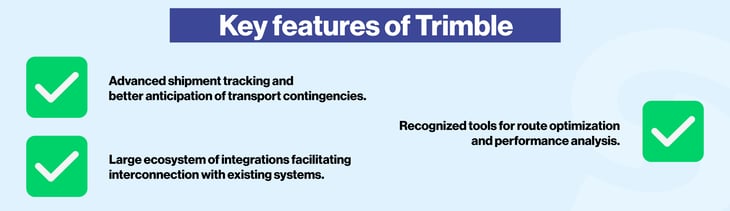
Trimble is positioned for high-powered applications requiring advanced data processing and extensive connectivity. Its strength lies in its ability to provide a predictive and structured vision of transport operations.
The solution is aimed primarily at organizations requiring multi-actor coordination and extended visibility of their flows.
Transics/ ZF: a global, automated vision of transportation
ZF offers a future-generation-oriented vision of transport, combining iot, automation and continuous development. The approach aims to orchestrate all transport operations, combining field data, automation and artificial intelligence.
This vision is aimed above all at structured, multi-site fleets, or those faced with complex planning and optimization issues.

Conclusion: trends for 2026 and how to choose?
In 2026, embedded computing will become a fully-fledged embedded system, at the heart of production, decision-making and field performance.
The right choice depends on your project, your needs, your budget, but also on the solution's ability to work, to ensure compliance and to last.
In this panorama, Sinari Telematics stands out for its industrial, robust, interconnected approach, designed for the realities of transport, with real business knowledge and a solution designed to support fleet transformation.

.webp)

.webp)

.webp)
.webp)
.webp)