

Sommaire
Digitization of the transport sector is no longer an option, but an inescapable reality. Faced with increasing volumes of goods to be handled, more complex flows and increasingly demanding customers, companies need to optimize their transport management, gaining in agility, visibility - thanks to real-time tracking - and decision-making capacity. This is where TMS software comes in, as a real strategic lever.
But one central question always comes up: should we opt for a SaaS-based TMS or an on-premise solution?
In 2025, the two models still coexist, but meet very different expectations-both in terms of operation and business experience. It's a structuring choice, which will have a direct impact on your transport costs, your customer satisfaction, and your ability to ensure continuous improvement of your logistics processes. Why not rely on the opinions of industry experts or real-life feedback to make the right choice?
👉 In this article, find out how to identify the best solution according to your selection criteria, internal constraints, efficiency objectives and desire to create added value.
Definitions & technological differences
Before comparing models on their concrete advantages, it's essential to understand what is meant by the terms SaaS, Cloud-hosted and On-Premise. These technological differences directly influence the cost, flexibility, level of customization and security of your future TMS.
On-Premise TMS: total control, but reliance on in-house infrastructure
An On-Premise TMS is software installed and hosted on the company's own servers, in its own premises or datacenters. The company owns it, buys a license and generally manages, maintains, updates and secures it with its IT teams.
✅ This model still appeals to some transport companies, particularly those with :
- stringent confidentiality or regulatory compliance requirements (e.g. defense, finance) ;
- complex information systems requiring extensive customization ;
- or a desire to maintain control over their entire infrastructure.
But it also implies a high initial investment (CAPEX), dependence on a strong IT team, and sometimes long deployment times.
Cloud-hosted TMS: outsourced hosting, without the flexibility of SaaS
A cloud-hosted TMS is a solution hosted remotely in a data center (often that of the publisher or a third party), but which can remain proprietary or customized. This model can be compared to a traditional license, but with outsourcing of the infrastructure.
It often represents an intermediate step between pure On-Premise and SaaS. Costs are more flexible, but the management logic remains close to the classic model: scheduled updates, shared maintenance, sometimes limited scalability.
🧩 This model may suit companies that already have a TMS in place, but wish to free themselves from hosting constraints without changing their solution.
TMS SaaS (cloud computing): agility, scalability and integrated service
The SaaS(Software as a Service) model is based on subscription-based access to the TMS via an intuitive interface, with no local installation or infrastructure management by the user company. The software is shared (often multi-tenant) with automatic updates and dashboards accessible from anywhere, hosted and maintained by the publisher, and accessible online via the web, 24 hours a day from any connected terminal.
This means :
- no initial investment in servers or heavy licenses ;
- rapid implementation, often in just a few weeks, to quickly manage your orders, vehicles and itineraries;
- automatic, continuous, uninterrupted updates;
- a complete solution with native scalability, ideal for growing companies or those with seasonal activities.
CAPEX vs. OPEX: a different budget logic
Beyond architecture, the choice between SaaS and On-Premise is also based on a different budgetary logic, impacting price, pricing and budget:
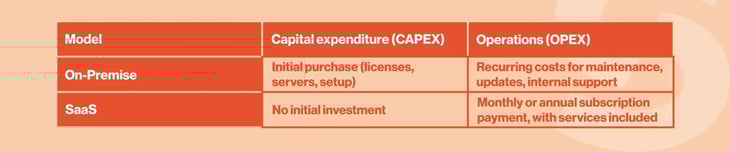
🎯 This distinction is strategic for companies seeking to preserve cash flow, smooth out expenses or adapt costs to business fluctuations.
Comparative advantages & limitations
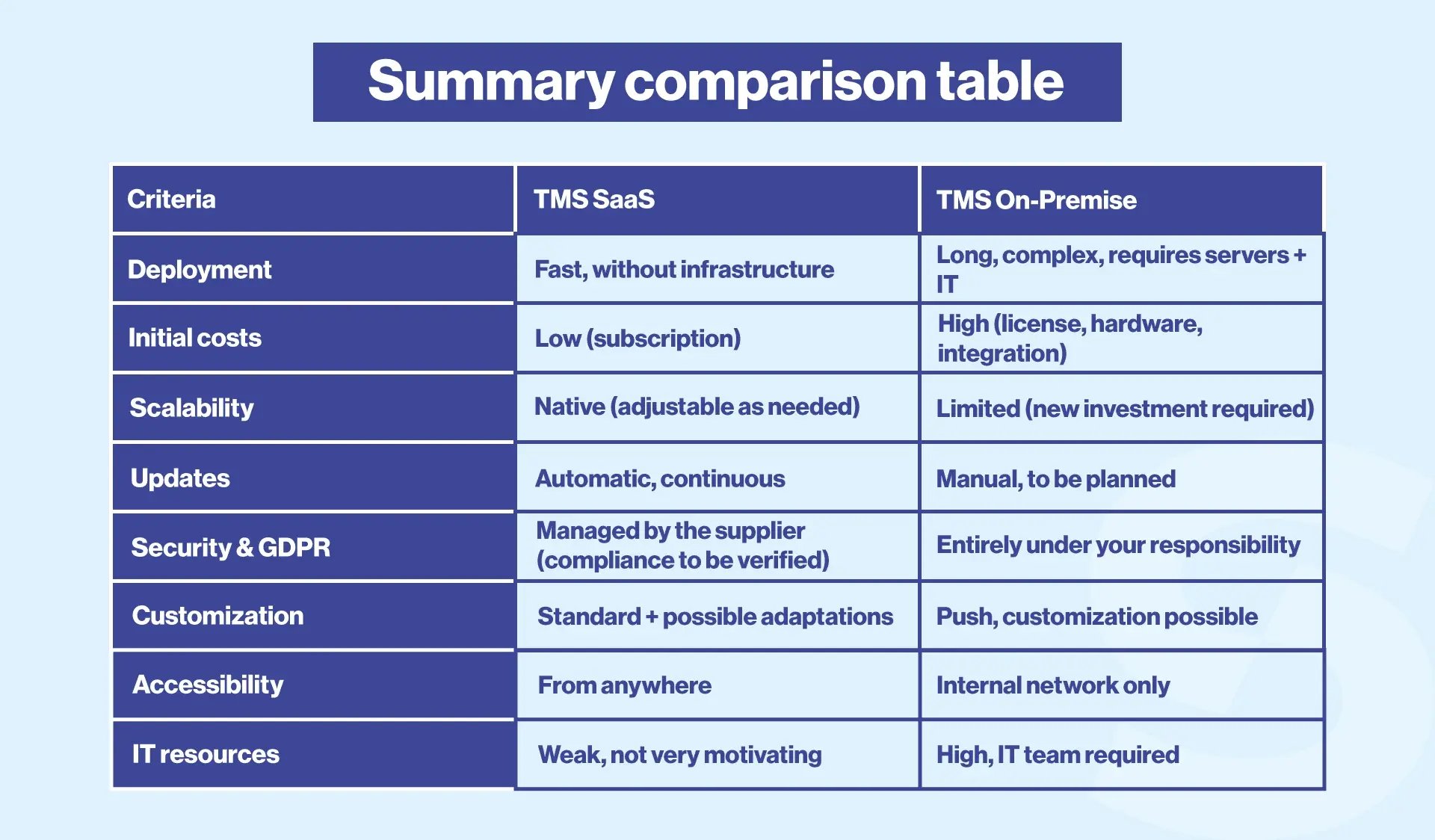
Choosing a TMS isn't simply a matter of deciding between two technical architectures: it's weighing up the benefits and constraints against your business priorities. Here's an objective overview of the strengths and limitations of the two main models.
TMS SaaS: agility, simplicity, scalability
👉 For whom: growing companies, multi-site organizations, logistics service providers, structures with few in-house IT resources.
✅ Key benefits
- Rapid deployment: up and running in just a few weeks, with no local installation - all you need is an Internet connection.
- Predictable costs: subscription with no surprises, no server purchases or hidden costs.
- Automatic updates: continuous functional upgrades, without interruption or IT mobilization.
- High availability: accessible 24/7, ideal for mobile, multi-site or telecommuting teams, in a context where remote working is becoming widespread.
- Native scalability: simple adjustment of users and connections according to activity.
- Easy scheduling: integrated modules for proactive management of contingencies and requests.
- Centralized tool: designed for operators, charterers and carriers, who want to consolidate all information in a single system.
❌ Limits to consider
- Limited customization: designed to cover 80% of standard needs; specific adjustments may require support
- Publisher dependency: hosting, security, updates... everything relies on a third-party partner - hence the importance of its commitments (SLA, support, compliance).
On-Premise TMS: control, customization, sovereignty
👉 For whom: companies with very specific needs, strong regulatory requirements or a desire for sovereignty (even if many large groups are now adopting SaaS).
✅ Key benefits
- Total control : complete management of hosting, security and performance.
- Advanced customization: tailored to internal processes and specific business constraints.
- Offline resilience: accessible even without a connection, ideal for mission-critical sites.
❌ Limits to consider
- Complex deployment: time-consuming project mobilizing hardware, IT and internal resources.
- High initial costs: significant investment in licenses, servers, integration.
- In-house maintenance: updates and support at your expense, IT team required.
Business selection criteria
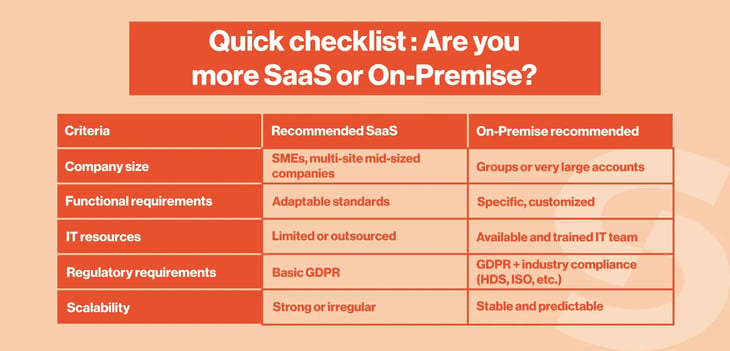
For comparable functionalities, the choice between a SaaS TMS and an On-Premise TMS depends above all on your operating context, your internal resources and your growth objectives. Here are the main factors to consider.
Company size, budget and internal resources
- For SMEs, a SaaS TMS is often more appropriate: rapid deployment, predictable budget, few IT resources required.
- For large groups or companies with a structured IS, an On-Premise TMS or advanced SaaS can offer more customization and control, at the price of a longer project and heavier investment.
👉 The more complex or international your flows, the greater the need for integration management or technical governance.
Functional customization
- SaaS covers 80% of standard needs, with an intuitive interface and packaged functions.
- If your processes are highly specific (multi-level chartering, waiting time management, ERP integration...), a customizable model - often On-Premise - may be required.
💬 SaaS mode does not rule out customization, but it is generally framed to guarantee the stability of the tool. To find out more about the key points to analyze, you can read our article Choosing a TMS software: everything you need to know.
Data sovereignty and compliance
- Some sectors (healthcare, defense, agri...) require localized hosting that complies with ISO, RGPD or HDS standards.
- In these cases, On-Premise mode or a dedicated SaaS hosted on French datacenters often becomes a business requirement.
💡 More and more SaaS providers are offering hybrid packages to reconcile flexibility and compliance.
Scalability and seasonality
- If you operate in an environment subject to variations in activity (seasonal peaks, multisite deployment...), a SaaS TMS is a clear advantage: rapid scalability, with no fixed additional costs, and real-time visibility of merchandise flows.
- Conversely, an On-Premise model may be appropriate if your business is more stable, centralized, and not subject to rapid change.
Practical impact on operations
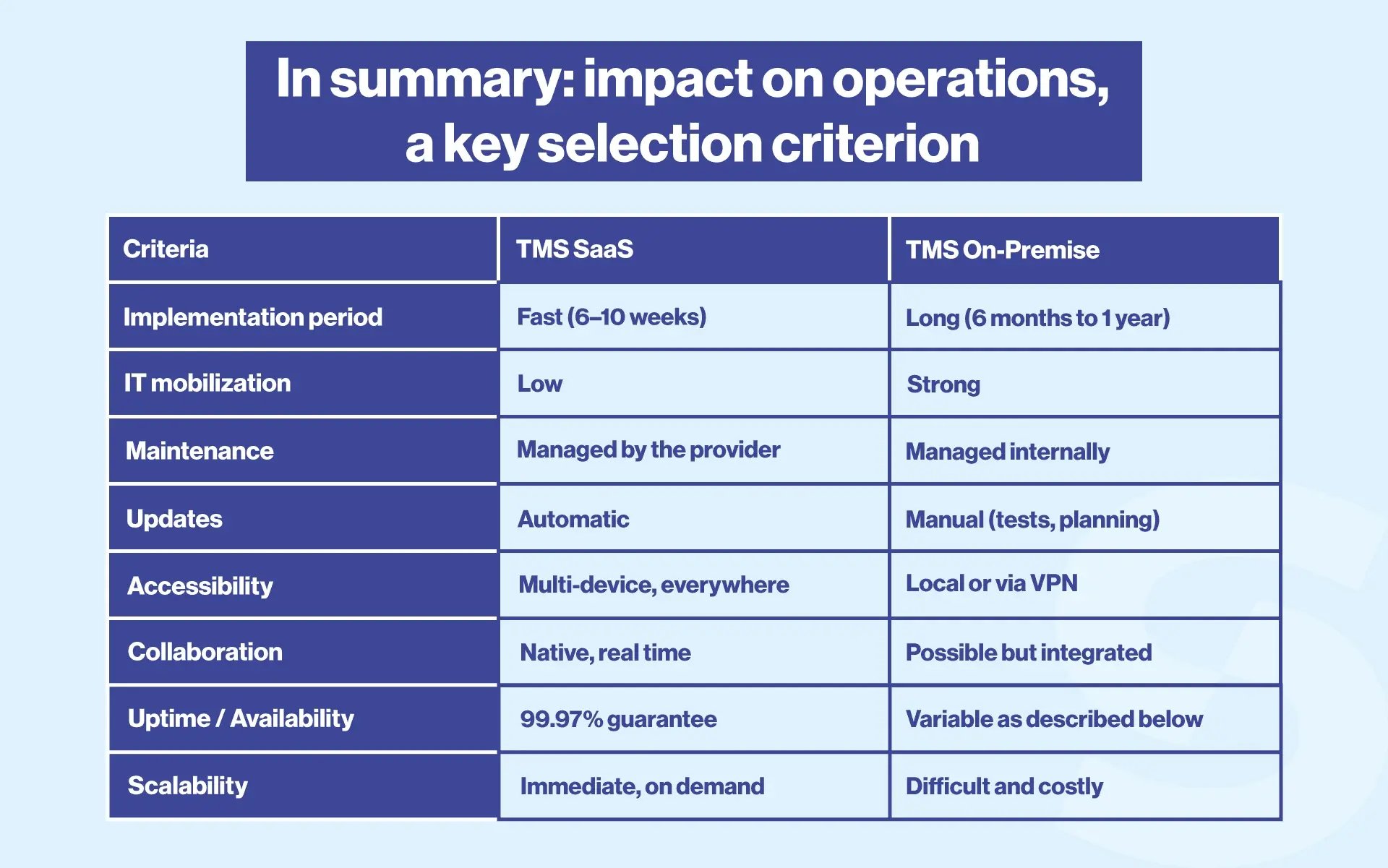
Choosing a TMS is about more than technical architecture. It has a direct impact on the way you manage your business on a day-to-day basis, on your human resources, your implementation times and your ability to collaborate effectively with your partners.
Here's a concrete overview of the operational impacts you need to anticipate.
Deployment: speed, IT dependency and flexibility
- SaaS TMS: deployment is often faster, with lead times reduced to a few weeks thanks to prepared connectors, ready-to-use environments and no-code interfaces.
➕ Useful for companies that want to test, pilot or scale quickly, without mobilizing their IT department for months on end.
➕ 100% remote deployment possible. - On-Premise TMS: requires a structured IT project with configuration on in-house or hosted servers, advanced parameterization, security audits, dedicated infrastructure.
➖ Delays often longer, dependent on internal cycles (purchasing, security, IT, testing...).
📝 Example: a multi-tenant SaaS TMS can be operational in 6 to 10 weeks, compared with 6 to 12 months for an On-Premise in a large organization.
Maintenance, support, updates
- TMS SaaS: Automatic updates without IT involvement. 24/7 support included (SLA, proactive supervision). High availability via redundant datacenters.
- On-Premise TMS: Maintenance at your expense or via service provider. Highly dependent on IT team. Updates can generate costs and interruptions.
💬 Modern SaaS TMS guarantee accelerated ROI, as the absence of manual maintenance frees up internal resources for higher-value tasks.
Cross-team collaboration and mobility
- TMS SaaS: Accessible on any connected terminal (PC, mobile, tablet). Promotes collaboration between sites, departments and partners through shared workflows and real-time notifications.
- On-Premise TMS: Less flexible for mobile users, except with VPN access or outsourcing solutions. Collaboration possible, but often restricted to the internal environment.
🎯 In the age of telecommuting and mobility, the ability to manage operations remotely is becoming a strategic lever for multi-site carriers, shippers or logisticians.
Risks of dependency or obsolescence
- With SaaS, the supplier controls the pace at which the tool evolves. This is an advantage (continuous innovation), but also a point of vigilance: you need to validate the product roadmap and commitments to maintaining operational conditions.
- In On-Premise, you have more control... but also the risk of ending up with a fixed tool, costly to maintain or upgrade (obsolete version, IT recruitment difficulties, dependence on external consultants).
🔎 This is where supplier support and transparency make all the difference, whether in SaaS or license + hosting.
TMS market trends & outlook
The evolution of transport management tools follows a fundamental trend: the rise of the SaaS model, particularly among SMEs, ETIs and fast-growing logistics service providers. The historically dominant on-premise model continues to exist, but is now confined to very specific needs.
The market of 2025 confirms that the best TMSs will combine flexibility, innovation and controlled costs.
Massive adoption of SaaS TMS
Most transport software publishers are observing a marked preference for SaaS solutions, with a view to simplification, rapid deployment and reduced infrastructure costs.
This trend is visible among shippers and carriers alike, with increasingly demanding use cases: multi-site management, multisystem integration, fine-grained traceability, real-time collaboration...
🔍 According to data shared by publishers, SaaS TMS would deliver ROI 2 to 3 times faster than a conventional model, thanks to the pooling of resources, continuous updates and increased automation of processes.
The key role of multi-tenant SaaS in innovation
The multi-tenant model, used by the majority of modern SaaS TMSs, enables several companies to share the same software infrastructure, while keeping their data perfectly isolated. This favors :
- lower entry costs,
- instant updates for all customers,
- and rapid integration of new technologies such asartificial intelligence, machine learning and advanced data visualization.
It is this architecture that makes possible innovations such as :
- AI-assisted prediction of delivery delays,
- AI-assisted email reading and automatic filling of TOs (transport orders),
- automatic suggestion of carrier assignments,
- or modeling logistics cost scenarios.
Players who rely on SaaS solutions can thus benefit more quickly from the latest technological advances, without development costs or overloading their IT teams.
Towards a hybrid model?
Some companies, particularly larger ones or those subject to strong regulatory constraints, are now considering hybrid models:
→ for example, a SaaS base for the majority of functionalities, coupled with private or dedicated hosting for certain sensitive data.
→ or a "license + hosting" logic, offering a compromise between SaaS flexibility and infrastructure control.
These models confirm one thing: there is no longer just one standard, but many possible combinations, to be adjusted to the specific challenges of each company.
Conclusion
✅ No universal model, but clear criteria
The choice between SaaS and On-Premise doesn't depend on an absolute truth, but rather on your business context, your fleet management, your ability to adapt your orders, your circuits, your teams, your vehicles, your itineraries...
- Are you looking for a tool that's quick to deploy, easy to upgrade, with predictable costs and delegated maintenance? TMS SaaS is the natural choice.
- Do you have a solid IT infrastructure, strong customization requirements or strict regulatory constraints? The On-Premise TMS may still be relevant.
What counts is making an informed choice, aligning technical aspects with your operational priorities, budget, ability to absorb a project, efficiency and medium-term ambitions.
💡 Contact our Sinari experts for a full TMS demo, from transport order planning to carrier tracking, in an efficient, fluid and easy-to-access environment.
.webp)

.webp)


.webp)

.webp)

.webp)