
Summarize this article with:
Sommaire
In the freight transport sector, the term artificial intelligence is everywhere: trade shows, specialist articles, conversations between managers, recommendations from editors... According to some speeches, AI is already capable of transforming the supply chain, predicting unforeseen events, optimizing every route and automating all operations.
The reality in the field is more nuanced.
Carriers, whether SMEs or large corporations, don't expect sophisticated or futuristic technology. They expect real gains: tools that save time, reduce costs, make data more reliable and improve the overall efficiency of their operations. Artificial intelligence is only of value if it can be simply integrated into an existing system, without creating disruption or risk for the organization.
It's with this pragmatic approach that we look at artificial intelligence applied to road transport: useful, but above all realistic and adapted to the business.
Automated data entry: the most mature use of AI in freight transport
What AI brings to the business
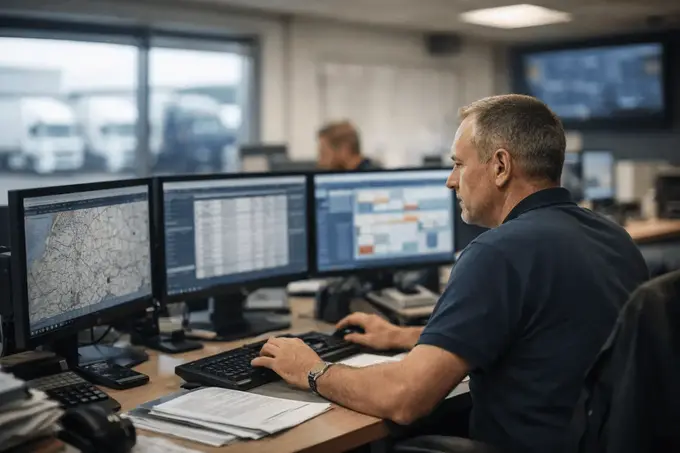
Manual data entry remains one of the most time-consuming tasks in day-to-day transport management. Between emails, PDFs, orders, customer exchanges or special instructions, operators are constantly juggling different sources of data.
This leads to :
- frequent errors,
- time-consuming re-entries,
- a heavy administrative burden,
- a lack of visibility on certain data flows.
Artificial intelligence now makes data processing more reliable, thanks to the automatic analysis of unstructured documents. For carriers, this is one of the most tangible uses of AI: an immediate gain in administrative workload and operational efficiency.
What Sinari does: Smart OT
With Smart OT, this automation becomes a simple reflex for operators. Simply launch an e-mail, PDF or document in the Sinari plug-in. The system analyzes the content, automatically identifies the key information, offers you a screen allowing you to adjust the data before generating a transport order directly in your business software, and then generates the transport order in the business software.
Result:
- up to 90% time saved on TO creation,
- fewer re-entry errors,
- a smoother process for the user,
- better data quality.
Available in Sinari TMS Ready and Sinari TMS Advanced, Smart OT is one of the most advanced examples of generative artificial intelligence truly useful for road transport. A concrete application, without overpromising, that illustrates the impact of intelligent automation on operations.
Route optimization: AI for greater productivity
What AI brings to the business
In a context of tight margins and rising costs (fuel, tolls, maintenance), every kilometer counts. Optimization algorithms are often associated with artificial intelligence in the transport sector. They enable direct action on field performance by optimizing routes, taking into account traffic, time, vehicle capacity and customer constraints.
They contribute to :
- reduce empty mileage,
- optimize freight flows,
- improve punctuality and customer service,
- reduce transport costs,
- reduce the environmental impact of emissions and fuel consumption.
Route optimization is one of the most proven applications in the freight transport sector. It's a technology already adopted by many companies, because it meets concrete business challenges.
What Sinari does: Sinari Optim
Sinari Optim is based on advanced algorithms capable of proposing an optimized plan in a matter of seconds, adapted to the fleet, the route, the company's constraints and customer expectations. This solution helps operators make faster, more accurate decisions, while facilitating cost control.
The benefits :
- reduced mileage,
- direct reduction in transport costs,
- better utilization of vehicles and drivers,
- improved customer service,
- continuous optimization of resources.
Sinari Optim can operate as a stand-alone application or be integrated with the TMS, providing companies with an effective, easy-to-use tool, without disrupting their working habits. A pragmatic approach that illustrates how digital optimization can improve operational efficiency without complicating the business.
Intelligent assistance for operations: automating what can be automated
What AI can do for the business
Artificial intelligence does not replace the key role of the operator in a transport company. On the other hand, it can help automate certain repetitive tasks to make operations smoother, faster and more reliable. In a way, it transforms the operator's role, while giving him room to shine.
These uses include, for example
- automated information formatting,
- consolidating data to facilitate decision-making,
- rapid identification of important elements in a document,
- reducing administrative back-and-forth.
For operators, this means: less workload, fewer errors, better visibility and real time savings on day-to-day operations.
Sinari's contribution today
Without promising uses still in the research stage in the European sector, Sinari already integrates several building blocks that contribute to this intelligent assistance:
- Smart OT, which automates the processing and analysis of transport orders,
- Sinari Optim, which automatically builds transport plans taking into account traffic and operational constraints,
- Sinari TMS, which centralizes data, optimizes its use and enhances the user experience,
- a business-oriented approach, focusing on ease of use and reduced handling.
The objective is the same for all: to offer intelligent, reliable tools adapted to field conditions, while facilitating adoption by teams.
Conclusion
Artificial intelligence applied to freight transport is not an abstract revolution. It has very concrete applications, such as automating data entry, optimizing routes and improving operational processes. Levers that enable carriers to cut costs, improve productivity, anticipate customer needs and reduce their carbon footprint thanks to optimized routes.
Sinari's approach is in line with this logic: to offer operational, simple and directly useful solutions, such as Smart OT and Sinari Optim, without promising technologies that are still inaccessible or not adapted to the realities on the ground. An approach based on business, on reliable data, and on a controlled digital transition.
In a world where mobility is evolving, regulations are tightening and sustainable development is becoming a priority, artificial intelligence offers interesting prospects for the transport sector. But it only makes sense if it really supports transport operators in their day-to-day challenges, by improving service quality and the overall performance of their operations.
.webp)
.webp)
.webp)

.webp)
.webp)