Sommaire
An incorrect delivery address, an incorrect weight, or a forgotten reservation: in the road freight industry, an error on the waybill can quickly complicate an operation. This document accompanies the shipment and contains the information essential to its smooth execution.
Beyond its administrative role, the waybill formalizes the terms of transport, facilitates inspections, and provides evidence in the event of a dispute. But you still need to know how to fill it out correctly.
What information is required? Who must prepare and sign this document? How can you avoid the most common mistakes? From paper to the electronic consignment note (eCMR), here are the key points to secure and simplify your transportation operations, particularly with Sinari’s mobility solutions.
What is a waybill?
Definition and Legal Status
A waybill is a transport document used in the road transport of goods. It formalizes the contract of carriage and identifies the parties involved, the goods being transported, and the main terms of the transaction.
In France, its contractual role is governed in particular by Article L.132-8 of the Commercial Code.
In practical terms, it serves as a reference in the event of a dispute. If goods arrive damaged, the information recorded at the time of pickup and delivery can help determine what happened and assign liability.
However, the waybill should not be confused with the delivery receipt. The former document pertains to the contract and the performance of the shipment, while the latter serves primarily to confirm the delivery of the goods to the recipient.
Who prepares the waybill: the shipper, the carrier, or the freight forwarder?
The preparation of a waybill can be handled by various parties involved in the operation.
The shipper hands over the goods to the carrier. The principal organizes or orders the service, while the freight forwarder, when involved, arranges the shipment on behalf of its client.
In practice, the transportation company may prepare the document based on the information provided at the time of the order.
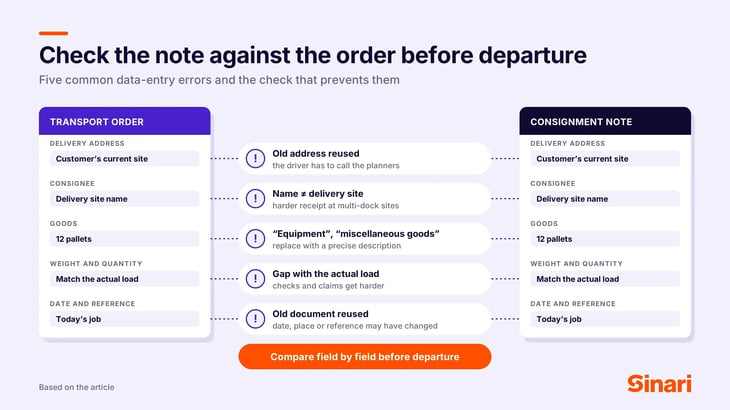
The key is that the information matches the actual planned shipment. Before departure, a joint verification between the operations department, the shipper, and the driver helps prevent errors in the address, recipient, or cargo.
How many copies are there, and who keeps which ones?
With a paper waybill booklet, multiple carbonless copies generally allow one copy to be given to the shipper, the carrier, and the consignee.
The number of sheets depends on the form used. Therefore, one should not assume that a set necessarily contains three or four copies in all situations.
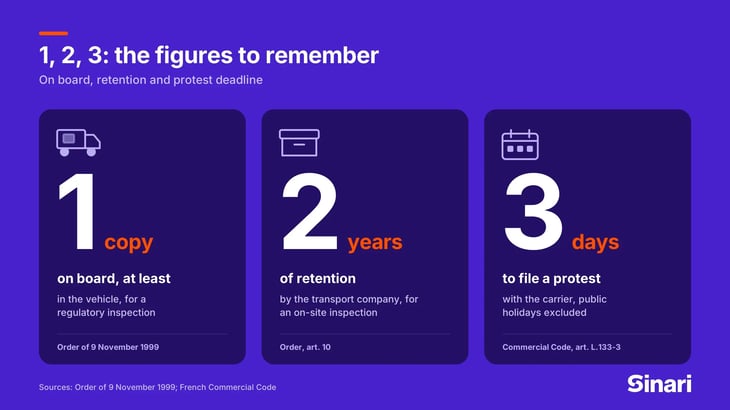
For shipments subject to the decree of November 9, 1999, at least one copy of the waybill must be on board the vehicle so that it can be presented during a regulatory inspection.
National Waybill or International CMR: What Are the Differences?
The national waybill: rules applicable in France
The national waybill applies to road transport operations carried out on French territory.
Its use is governed in particular by the Commercial Code and the decree of November 9, 1999, regarding the transport documents that must be carried on board vehicles.
For a public road freight transport company, this document identifies the shipment and verifies the information regarding the transport operation.
Transportation for own account is subject to specific documentation requirements: therefore, the same rules should not automatically be applied to all companies transporting goods.
The International Waybill: The Framework of the CMR Convention
When a shipment involves the international transport of goods by road, it may be governed by the CMR Convention, signed in Geneva on May 19, 1956.
This convention governs, in particular, the international contract of carriage, the information contained in the CMR consignment note, and the liabilities of the various parties.
Its application depends on the conditions set forth in the convention, particularly whether the places of pickup and delivery are located in two different countries, at least one of which must be a contracting state.
How do you know which waybill to use?
Let’s consider two examples.
A shipment between Rennes and Lyon falls under French domestic law. In contrast, a shipment from Rennes to Brussels constitutes international transport that may be subject to the CMR Convention.
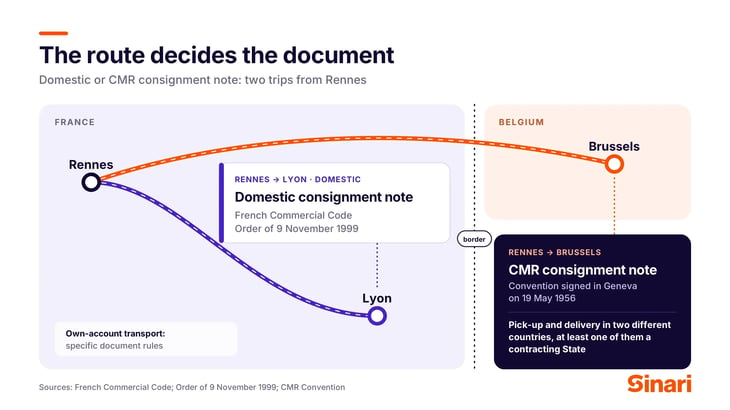
It is therefore necessary to examine the route and the legal framework of the contract, rather than choosing the document solely based on the form available within the company.
What information must be included on a waybill?
A waybill must contain sufficient information to identify the shipment and the goods in question. But be careful: not all fields on paper forms necessarily correspond to the same regulatory requirements.
The eight minimum pieces of information required by the decree of November 9, 1999
Article 4 of this decree specifies eight categories of minimum information:
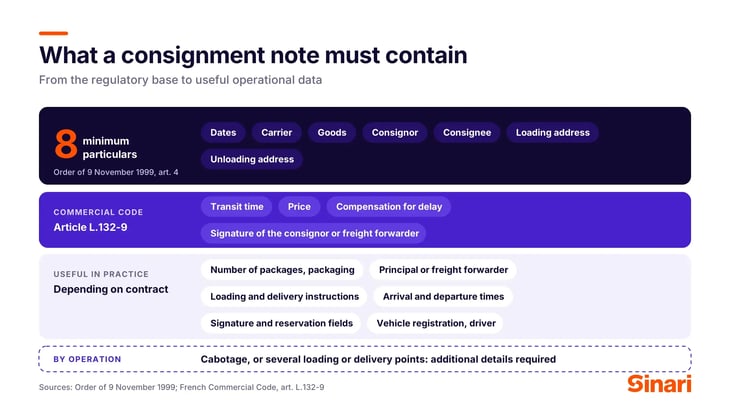
This information constitutes the minimum requirements for the transport document specified by this decree.
It must be sufficiently precise to identify the shipment. A description of the cargo that is too vague or an incomplete address can complicate both the driver’s work and the checks performed by the company.
Additional Information That Should Not Be Overlooked
In addition to these eight items of information, other details may be required depending on applicable legal provisions, contractual terms, and the specific nature of the shipment.
Article L.132-9 of the Commercial Code specifically requires details regarding the transit time, the price, the compensation due in the event of a delay, and the signature of the shipper or freight forwarder.
In practice, it is also useful to include:
- The number of packages, their packaging, or their reference numbers.
- The contact information of the shipper or freight forwarder.
- Any special loading and delivery instructions.
- Arrival and departure times, when tracked.
- Spaces for signatures and reservations.
The vehicle registration number and the driver’s identification may facilitate tracking of the shipment, though these are not required to appear on every domestic waybill.
Specific Rules Depending on the Operation
Certain situations require additional details.
This is particularly the case for cabotage, for which regulations require additional information. Specific procedures also apply to shipments involving multiple loading or delivery operations.
It is therefore important to adapt the document to the actual activity being carried out.
How to Fill Out a Waybill Without Errors?
A correctly filled-out waybill starts with reliable information. Before loading, a few simple checks can help avoid problems during the delivery route or at the time of billing.
The most common data entry errors
1. An incorrect delivery address
An old customer address may be mistakenly included on a document. The driver must then contact dispatch to confirm the destination, which can disrupt their route.
2. An incorrectly identified recipient
When the recipient’s name does not match the delivery location, receiving the shipment can become more complicated, especially at facilities with multiple departments or loading docks.
3. An imprecise description of the goods
Simply listing “equipment” or “miscellaneous products” does not always clearly identify the shipment. It is best to use a precise description that matches the order details.
4. Incorrect weight or quantity
A discrepancy between the waybill and the goods actually transported can complicate verification and the investigation of a potential claim.
5. Information Copied Without Verification
When a carrier prepares multiple similar shipments, it can be tempting to reuse a previous document. However, the date, delivery location, or reference number may have changed.
The best practice is to compare the information on the waybill with that on the shipping order before departure.
Delivery Reservations: What Should Be Written and When?
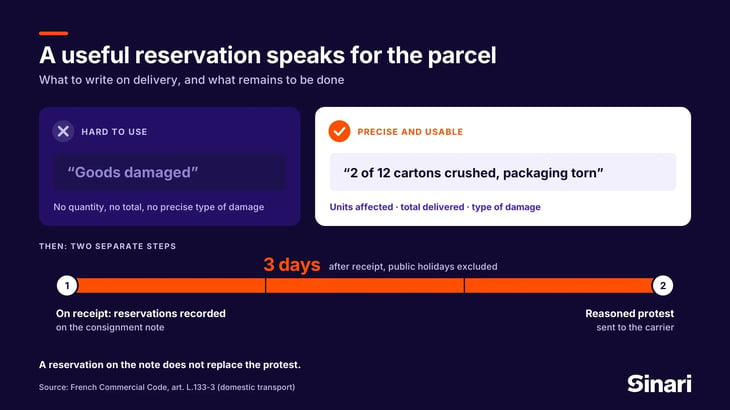
Upon delivery, the recipient may notice an issue: a missing package, torn packaging, damaged goods, or a quantity that differs from what was stated.
In this case, the reservations must describe the observed facts precisely.
For example, the note “2 of 12 boxes crushed, torn packaging” is much more useful than a simple statement such as “damaged goods.”
These observations must be recorded at the time of receipt when an issue is detected. The recipient must also ensure that the complaint procedures are properly followed.
For domestic shipments subject to the Commercial Code, Article L.133-3 specifically requires a reasoned complaint to be sent to the carrier within three days of receipt, excluding holidays, in accordance with the legally prescribed procedures.
Entering a reservation on the waybill therefore does not automatically exempt the recipient from taking the other necessary steps.
How long should a waybill be retained?
Article 10 of the decree of November 9, 1999, stipulates that the relevant documents must be retained by the transportation company for two years so that they can be presented during an on-site inspection.
This retention period does not replace any other potential retention obligations related to accounting, tax, or contractual documents.
To easily locate a document, it is advisable to organize your files by date, customer, or shipment reference and to keep copies in a legible condition.
Waybill Template and Paper Logbooks: How to Stay Organized?
What must a waybill template contain?
A waybill template must include the applicable regulatory information and allow for the addition of details specific to the shipment.
Here is a simplified example of the sections to include:
| Section | Example of Information |
|---|---|
| Shipment Reference | OT-2026-001 |
| Carrier | Company, address, SIREN |
| Shipper | Name and loading location |
| Recipient | Name and delivery location |
| Goods | 12 pallets of packaged products |
| Pickup | Scheduled or actual date |
| Remarks | Issues identified, relevant instructions |
| Receipt | Date, recipient’s name, signature, and any reservations |
This example is intended as an organizational aid, not a universal legal template. The document used must be tailored to the type of transport being carried out.
Where can you buy a waybill book, and how much does it cost?
Waybill books are available from suppliers specializing in shipping documents and professional printers.
Options include carbonless copies, preprinted booklets, and custom designs featuring the company’s contact information.
The price generally depends on the format, the number of sheets, the quantity ordered, and the customization options.
What are the limitations of the paper format?
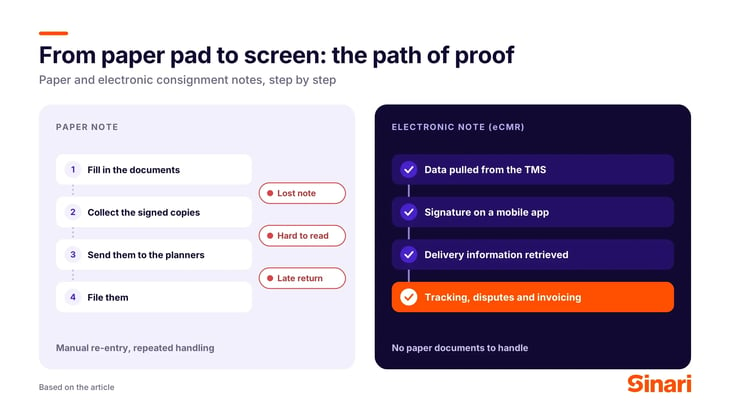
For a company that handles multiple shipments every day, managing paper documents can involve a lot of manual work.
Documents must be filled out, signed copies collected, forwarded to operations, and filed. A lost, illegible, or late-returned waybill can also complicate the administrative tracking of the shipment.
These challenges highlight the benefits of digitizing waybills to streamline their transmission, tracking, and retrieval by the operations department.
How do you generate a waybill from your operations system?
Reuse the information available in the TMS
In a transportation company, much of the data required for the waybill is already entered during job preparation: client, recipient, loading location, delivery location, and cargo specifications.
A TMS capable of reusing this information to prepare shipping documents minimizes manual re-entry and helps reduce inconsistencies.
For operations, the benefit is clear: less time spent re-entering the same information and greater consistency between the transport order and the documents accompanying the cargo.
Sinari’s TMS solutions enable structured management of transportation operations, with documentation capabilities that depend on the selected products and configurations.
From Paper Letters to Electronic Signatures
Beyond document preparation, some companies choose to digitize their management processes.
The electronic waybill, or eCMR, enables digital management of information and the transport approval process. Using a mobile app, the driver can, for example, have documents signed directly upon delivery, without having to handle paper documents.
With Sinari’s mobility solutions, this digitization streamlines communication between drivers and operations, while speeding up the retrieval of delivery information.
To learn more about this topic, discover how the eCMR and in-vehicle computing integrate into transportation operations.
Streamlining the Return of Proof-of-Delivery Documents
The smooth flow of documents is also important after delivery.
When signed copies and notes can be quickly retrieved by operations, teams have easier access to the information needed to track shipments, resolve disputes, and prepare invoices.
This is also one of the key challenges of managing digital shipping documents.
Conclusion
The waybill plays an essential role in the road transport of goods. When properly completed, it clearly identifies the shipment, facilitates inspections, and preserves useful information in the event of a dispute.
To avoid errors, three key practices are particularly important: verifying the required information, accurately documenting discrepancies, and organizing the storage of copies.
In addition to these best practices, transportation management and digitization solutions—such as those offered by Sinari—help ensure the reliability of information, facilitate delivery tracking, and simplify day-to-day operations for both drivers and operations staff.