
Sommaire
At a DREAL inspection site or when passing through a weigh station while driving, the penalty is imposed quickly: a 5-axle articulated combination limited to 40 metric tons—or 44 metric tons under certain conditions—by Article R312-4 of the Highway Code, with an axle load governed by Articles R312-5 and R312-6, and an overload that can result in a fine, unloading of excess cargo, and immobilization of the vehicle.
For UNICEM-member quarries and sand pits, as well as for carriers represented by the FNTR or the OTRE, the issue goes beyond mere compliance. Overloading a truck carrying aggregates depends as much on the axle load as on the gross vehicle weight rating (GVWR): a target load—calculated based on the truck’s payload and the material’s bulk density, then verified at the quarry’s weighbridge—protects the carrier from fines and immobilization while ensuring the profitability of each trip.
Because the opposite mistake also comes at a cost: an underloaded 8x4 truck means lost revenue as it leaves the site. Here’s how to calculate, distribute, manage, and share this target load, from the quarry to the construction site.
Overloading an aggregate truck: What are the actual risks for the carrier?
Overloading an aggregate truck is a violation of the traffic code, according to Article R312-2, which prohibits operating a vehicle whose actual weight exceeds its gross vehicle weight rating (GVWR). For the carrier, overloading trucks has consequences on three fronts. First, fines that accumulate for each excess weight bracket, whether for gross vehicle weight rating (GVWR) or axle weight. Second, operations brought to a sudden halt on the side of the road. Finally, liability that can extend all the way back to the shipper and the principal, according to the DREAL Rhône-Alpes. Setting a target load before departure eliminates these three risks.
What limits must be observed: GVWR, 44 metric tons, axle load?
The GVWR—the maximum authorized weight of an aggregate truck—depends on its configuration. These weight limits, set by regulation, are 19 metric tons for a two-axle truck, 26 metric tons for a three-axle truck, and 32 metric tons for an 8x4 truck. In addition, the weight on each axle must remain below its own limit.
A five-axle combination has a maximum authorized gross vehicle weight of 40 metric tons, increased to 44 metric tons for transport carried out entirely within the national territory under the conditions of Decree No. 2012-1359, in accordance with Article R312-4 of the Highway Code. Articles R312-5 and R312-6, meanwhile, establish the maximum load for the heaviest-loaded axle and for a group of axles, based on their spacing.
| Configuration | Limit | Reference Text |
|---|---|---|
| 2-axle truck (4x2) | 19 t (GVW) | Art. R312-4, I |
| 3-axle truck (6x4) | 26 metric tons (GVWR) | Art. R312-4, I |
| 4-axle truck (8x4) | 32 metric tons (GVW) | Model R312-4, I |
| 4-axle articulated truck | 38 metric tons (gross combination weight) | Art. R312-4, II |
| Articulated combination with 5 or more axles | 40 metric tons (GVWR), 44 metric tons for domestic transport under certain conditions | Art. R312-4, II and III; Decree No. 2012-1359 |
| Heaviest-loaded axle | 13 metric tons (12 metric tons for a combination exceeding 40 metric tons) | Art. R312-5 |
| Axle group (tandem, tridem) | Varies depending on the track width | Art. R312-6 |
However, according to the DREAL Rhône-Alpes, the applicable limit remains the Gross Vehicle Weight Rating (GVWR) listed in Section F2 of the registration certificate, even when it is lower than the regulatory maximum. Your target load must therefore always be based on the lower of these two limits: the vehicle’s or the axle’s.
How is overloading monitored and penalized?
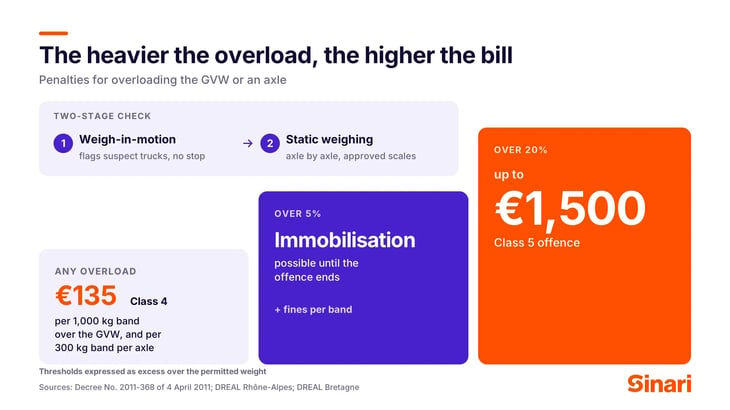
Overloading is monitored in two stages. In-motion weigh stations, integrated into the roadway, identify suspicious heavy-duty vehicles without stopping them. DREAL inspectors or law enforcement officers then perform a static weigh-in, axle by axle, using equipment that is certified and inspected annually, according to DREAL Bretagne. The penalty is a 4th-class traffic violation of €135 per 1,000 kg over the gross vehicle weight rating (GVWR) and per 300 kg over the axle weight limit, according to Decree No. 2011-368 of April 4, 2011. If the excess exceeds 20%, the offense is classified as a 5th-class violation, with a fine of up to €1,500.
If the overload exceeds 5%, the vehicle may be impounded until the violation is rectified, according to the DREAL Rhône-Alpes. For the carrier, the hidden costs often exceed the fine: unloading at the roadside, a replacement truck, and delayed construction work. Adhering to the target load from the start prevents this scenario.
Carrier, shipper, principal: who is liable?
The carrier is not the only party liable for overloading: responsibility is shared among the driver, the shipper, and the principal, depending on each party’s role. The driver remains primarily responsible, as they cannot ignore the weight listed on the weigh ticket issued by the quarry, according to the DREAL Rhône-Alpes. For shipments of 3 metric tons or more, the loading, securing, and stowage of the goods are carried out by the shipper, in accordance with Article 7.2.1 of the general standard contract, annexed to Article D3222-1 of the Transport Code. This rule therefore applies equally to members of UNICEM and those of FNTR.
Criminal liability thus depends on the actual division of roles. A shipper who imposes an unreasonably low price per metric ton is liable for a 5th-class fine of up to €1,500 per shipment, according to the DREAL Rhône-Alpes. The quarry, which loads, weighs, and issues the bill of lading, is best positioned to determine the target load.
What is the target load, and how is it calculated?
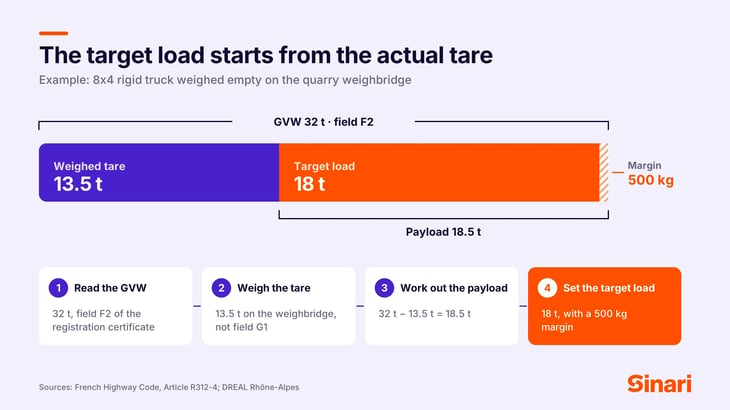
The target load is the tonnage of material to be loaded so that a truck departs as close as possible to its limits without ever exceeding them—neither underloaded nor in violation of regulations. It is derived from the available payload: this actual carrying capacity is the difference between the gross vehicle weight rating (GVWR; section F2 of the registration certificate) and the curb weight (section G1), according to the DREAL Rhône-Alpes.
This theoretical empty weight changes over time: with added equipment and residue stuck to the bottom of the dump truck bed, the actual tare weight often exceeds the value listed on the vehicle registration certificate. The reliable tare weight is the one measured when the vehicle is empty on the quarry’s weighbridge, a device verified annually by an accredited body, according to DREAL Rhône-Alpes. A 32-metric-ton 8x4 truck weighing 13.5 metric tons when empty offers 18.5 metric tons of payload. Aiming for 18 metric tons leaves a 500-kilogram margin to account for bucket volume variations. This tonnage must then be converted to volume.
How do you calculate the available payload of a dump truck?
The available payload of a dump truck is calculated by subtracting the actual curb weight from the vehicle’s maximum allowable mass. For a single-unit truck, this is the gross vehicle weight rating (GVWR) minus the tare weight. For an articulated combination, it is the gross combination weight rating (GCWR) minus the tare weights of both the tractor and the semi-trailer, according to the OPPBTP.
Road transport remains the dominant mode of transport for aggregates, accounting for 77% of ton-kilometers in 2017, far ahead of rail and waterways, according to the DREAL Hauts-de-France. Its two dominant configurations in quarries do not offer the same efficiency. An 8x4 truck with a gross vehicle weight rating (GVWR) of 32 t hauls approximately 18 t. A five-axle semi-dump truck with a gross combination weight rating (GCWR) of 44 t, in domestic transport, with a combined curb weight of 14 to 15 t, hauls nearly 29 t. This 11-metric-ton difference per trip helps in selecting the vehicle, but remains theoretical until access to the job site and the unloading area have been confirmed. The target load is therefore determined on a vehicle-by-vehicle basis, never by category.
Why maintain a safety margin below the gross vehicle weight rating (GVWR)?
The safety margin protects your target load from two uncertainties that the GVWR does not account for. The first relates to weighing. A quarry’s weighbridge is a device subject to legal metrology, with a maximum permissible error and periodic verification. Roadside inspection scales also have their own tolerance. The margin therefore depends on the cumulative error of these two weighings.
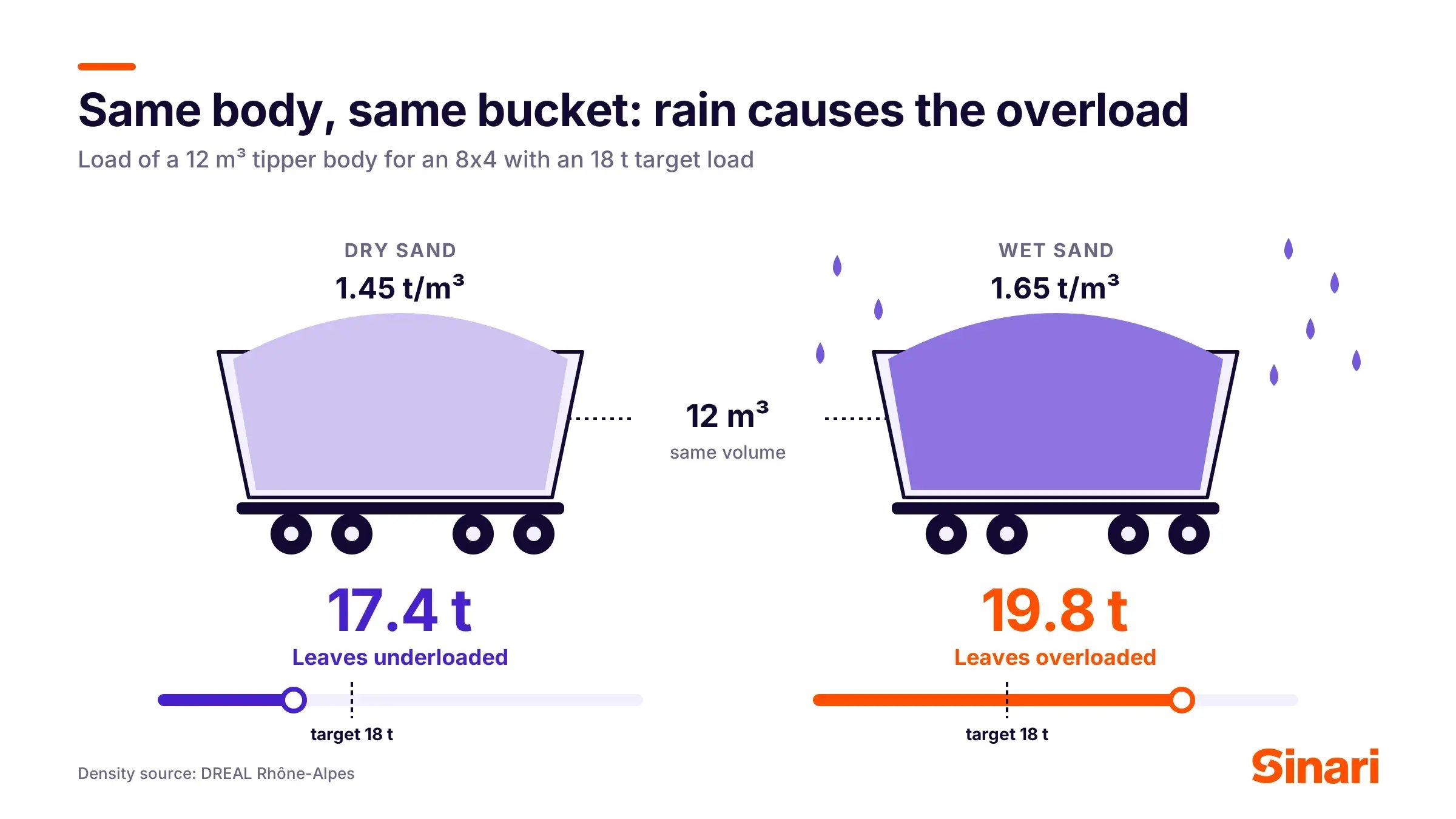
The second relates to the material. The bulk density of sand ranges from 1.45 t/m³ when dry to 1.65 t/m³ when wet, according to the DREAL Rhône-Alpes, which skews any load estimated by the bucket. As for the 5% immobilization threshold, set by Decree No. 2011-368, this is not a tolerance. Aim to stay below the gross vehicle weight rating (GVWR); never reach its limit.
Overloading or Underloading: How Much Does Deviation from the Target Load Cost?
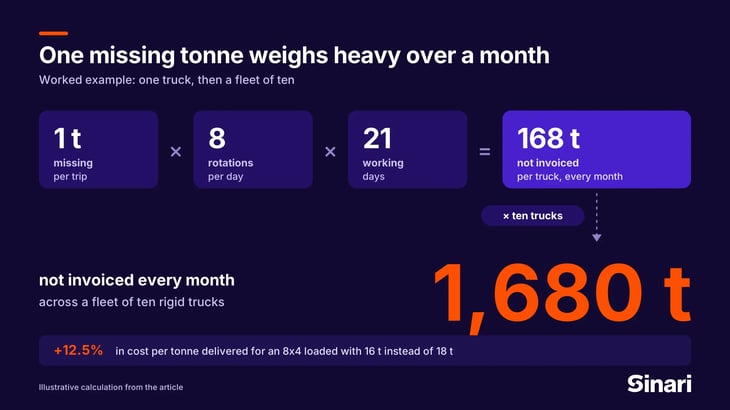
Overloading and underloading are two sides of the same deviation from the target load, and each erodes profitability per trip. Underloading, unlike overloading, is no less costly. Each trip requires the same driver time, nearly the same amount of diesel fuel, and the same tolls, but delivers fewer metric tons. An 8x4 truck loaded with 16 metric tons instead of 18 metric tons thus sees its cost per metric ton delivered increase by 12.5%.
Overloading, on the other hand, yields no benefit: according to the DREAL Rhône-Alpes, there is no compensation for the excess metric tons, even though they expose the operator to penalties and accelerate vehicle wear and tear. In both cases, the profit margin is lost as soon as the truck leaves the quarry.
What are the hidden costs of overloading?
The hidden costs of overloading far exceed the fine, and most do not appear on any line of the operating statement. The most significant cost is related to insurance: in the event of an accident involving a vehicle in violation of weight limits, the insurer may legitimately refuse to pay compensation, according to the DREAL Rhône-Alpes. This undermines the carrier’s fleet insurance and can affect the renewal of the policy. Added to this are potential criminal liability following a serious accident for endangering the lives of others, possible penalties for project delays, and the loss of trust from a dissatisfied customer. These hidden costs stand in contrast to the compensatory overload—the practice of adding a metric ton to make up for an underpriced shipment. Beyond the target load, each additional metric ton costs more than it brings in.
How much does an underloaded trip cost?
An underloaded trip costs as much as a fully loaded one but delivers fewer metric tons. The cost per metric ton transported is the total cost of a trip divided by the metric tons actually delivered. This is a cost-of-production logic that the National Road Committee (CNR) breaks down by the hour and by the kilometer. Underloading therefore results in a loss of revenue on every trip, since aggregates are sold by weight, while also increasing the cost per metric ton delivered.
The monthly calculation is simple. Let’s assume 1 metric ton missing per trip, with 8 trips per day and 21 working days: that amounts to 168 metric tons not billed per truck. For a fleet of ten trucks, that’s 1,680 metric tons each month. Comparing each weigh-in to the vehicle’s target load is enough to identify these shortfalls. However, this tonnage must be properly distributed.
Compliance with the GVWR is not enough: the load must be distributed across the axles
Compliance with the GVWR does not guarantee overall compliance: a truck may display the correct total weight but still be in violation of the axle load limit. In a dump truck, load distribution depends on where the load is deposited. A pile placed too far back overloads the rear axles, while a pile close to the front of the truck overloads the front. Poor load distribution is therefore enough to cause an axle overload even when the total weight is the same.
Article R312-6 of the Highway Code sets a maximum load limit for a tandem or tridem axle based on the distance between the axles. The carrier must provide the shipper with the necessary information to ensure a balanced load distribution and compliance with the maximum axle load, in accordance with Article 7.2.1 of the general standard contract. The target load is therefore also defined by its position in the truck bed, and not merely by its tonnage.
Why can a truck have an axle overload without exceeding its gross vehicle weight rating (GVWR)?
Axle overload without exceeding the GVWR is due to a shift in weight distribution: the total weight remains within legal limits, but a group of axles is carrying more than its own limit. The weight per axle depends on the load distribution, not just on the total tonnage. On an 8x4 truck, the front axle and the rear tandem each have their own weight limits. If the center of gravity of the load shifts backward, the rear axles will bear the brunt of the excess weight. An overloaded axle impairs handling and increases braking distance.
The pitfall lies in the measurement. A single-deck weighbridge at a quarry displays a total weight, whereas mobile weigh stations preselect heavy trucks based on both total weight and axle load, according to the FNTP, before performing a static axle-by-axle weighing. A truck that is in compliance when leaving the site may therefore be ticketed on the road. It is advisable to check the target load by axle, at least occasionally for the most at-risk configurations.
How should the load be positioned in the dump truck during loading?
Load positioning begins with the very first scoop. It must be deposited in the center of the dump body, between the axles, before being filled out toward the front and then toward the rear, to create a spread-out pile rather than a lopsided mound. In practice, the machine operator counts the number of passes, maintains the same number of passes from one truck to the next for the same material, and levels off the top before departure. Proper positioning therefore relies on practices that depend on the operator’s expertise: it is best to put these in writing for the entire loading team.
The safety protocol is mandatory for all loading operations carried out by an outside contractor, according to Article R4515-4 of the Labor Code. The quarry may specify, for each truck type, the number of passes and the drop-off zone corresponding to the target load.
How do you manage the target load based on cost per metric ton delivered?
The target load isn’t set once and for all: it’s measured load after load, then adjusted. Your compliance metrics are derived directly from the weigh-ins. These include the average deviation from the target per vehicle, the percentage of trucks that exceeded or fell below the tolerance, and the cost per metric ton delivered per customer.
The quarry’s weighbridge remains the standard, as it is a regulated instrument whose weighings form the basis for weight-based billing, in accordance with Decree No. 2001-387 on the control of measuring instruments. The carrier’s onboard weighing system complements this upstream by guiding the loading process before the truck passes over the scale. Together, they make profitability per cycle a key metric—and therefore one to be optimized.
Weighbridge or On-Board Weighing: How Do They Complement Each Other?
Weighbridges and on-board weighing systems generally serve two distinct roles: the former certifies the weight, while the latter guides the loading process. However, some on-board weighing systems—whether mounted on a loader or a truck—are certified for commercial transactions and can therefore serve as the basis for billing. The weighbridge falls under the purview of legal metrology, as a non-automatic weighing instrument governed by Directive 2014/31/EU. At most sites, it serves as the authoritative source for the weigh slip and invoicing.
However, it comes into play after the fact. At quarries, any excess weight detected during weighing must be unloaded before departure, according to the DREAL Rhône-Alpes, which sends the truck back to the stockpile and extends its turnaround time. On-board weighing breaks with this practice of a single weighing at the site exit. Installed by the carrier, it displays the weight load by load—and sometimes the weight per axle—which the single-platform scale does not show. Loading then stops at the target weight instead of being corrected after the fact.
What metrics should be tracked per rotation and per vehicle?
The metrics to track consist of four figures, all derived from your weigh-ins and sorted by license plate:
- The deviation from the target tonnage, both as an average and in terms of variation. A truck that consistently runs 300 kg below the target is easier to correct than one that fluctuates.
- The unloading rate, i.e., the percentage of trucks sent back to the warehouse before departure.
- The actual tare weight recorded at each empty weigh-in, to track any drift.
- The cost per metric ton delivered, which must be recalculated regularly since its components change: the CNR publishes a monthly index of commercial diesel prices.
This weighing history is directly derived from the target load: without a set loading target for each vehicle, the quarry cannot measure any deviations.
Density and moisture content: why does the quarry hold the key to the target load?
Bulk density links what the quarry weighs to what the construction site orders. The customer often expresses their needs in cubic meters of sand, gravel, or crushed stone; the hauler in dump truck volume; and the quarry in metric tons: without reliable density data, the target load calculated above remains merely an intention.
However, the density of aggregates varies depending on the type of rock—which differs from one region to another—as well as the particle size distribution and moisture content of the stockpile, three parameters known only to the quarry. France consumes approximately 400 million metric tons of aggregates per year, including 300 million metric tons of natural aggregates, according to UNICEM, and each product has its own density. Sharing this data shifts the focus from calculation to coordination.
What is the density of aggregates depending on the material?
The bulk density of aggregates ranges from approximately 1.4 to 2 t/m³ depending on the material, its particle size distribution, and its moisture content, according to Eurocode 1 values. Fine-grained sand, gravel, and mixed aggregate—three types of aggregates—do not have the same shape or the same void ratio. Sand refers to an aggregate with a maximum particle size not exceeding 4 mm, according to the NF EN 12620 standard—a classification followed by UNPG member producers.
| Material (bulk) | Approximate bulk density | Source |
|---|---|---|
| Dry sand | 1.45 t/m³ | DREAL Rhône-Alpes |
| Wet sand | 1.65 t/m³ | DREAL Rhône-Alpes |
| Stored, dry sand | 1.43–1.94 t/m³ | Eurocode 1, Table A.7 |
| Bulk gravel, uncompacted | 1.53–1.63 t/m³ | Eurocode 1, Table A.6 |
| Bulk gravel-sand mixture | 1.53 – 2.04 t/m³ | Eurocode 1, Table A.7 |
The bulk density directly determines the actual loaded mass. A single 12 m³ dump truck load weighs 17.4 t when filled with dry sand at 1.45, but 19.8 t when filled with wet sand at 1.65. For an 8x4 truck with a target load of 18 t, the first dump truck leaves underloaded and the second overloaded. The reference value is that listed in the product data sheet, established by each quarry as part of the CE marking for aggregates.
Why is a truck carrying wet sand more often overloaded?
Wet sand more often causes trucks to be overloaded because water adds mass without adding volume. For the same number of buckets, the water content directly increases the actual loaded mass. Its bulk density increases, but the machine operator still sees the same load.
Moisture also affects the mass per axle: wet, cohesive sand does not spread out well, remains in a pile where the bucket drops it, and concentrates its weight on a single set of axles. The cumulative precipitation totals published daily by Météo-France make it possible to anticipate these rainy spells. On days when outdoor stockpiles are saturated with water, the target load must be achieved with fewer bucket passes. This information must then be relayed to the right truck at the right time.
Time Slots and Instructions: Load It Right the First Time
Loading slots are the time when the target load is transferred from the quarry to the carrier. Coordination between the quarry and the construction site largely depends on these slots, which are scheduled based on the availability of equipment and stockpiles. Reserving a slot involves declaring in advance the vehicle, its profile, the product, the expected quantity, and the delivery method, so that the machine operator knows the target load before the truck arrives. This exchange is not optional: the shipper must inform the carrier of the nature and weight of the goods, in accordance with Article 3 of the general model contract, annexed to Article D3222-1 of the Transportation Code. Planning based on this information ensures that the load is loaded correctly the first time.
How does waiting at the quarry lead to overloading?
Waiting at the quarry leads to overloading through a simple calculation: every hour lost in the line costs one trip, and the carrier seeks to make up for it in tonnage. Queues thus lead to compensatory overloading. This is often encouraged by a client who sets a tonnage target and a deadline without taking transit time into account.
The strain runs through the entire supply chain. The FNTP represents the public works companies that order aggregates, the FNTR represents the carriers that deliver them, and neither has control over the line. The quarry, however, does. By reducing truck wait times at the quarry, it makes profitability per rotation compatible with the target load: the number of trips increases, not the tonnage per trip.
How do you transmit loading instructions for each vehicle?
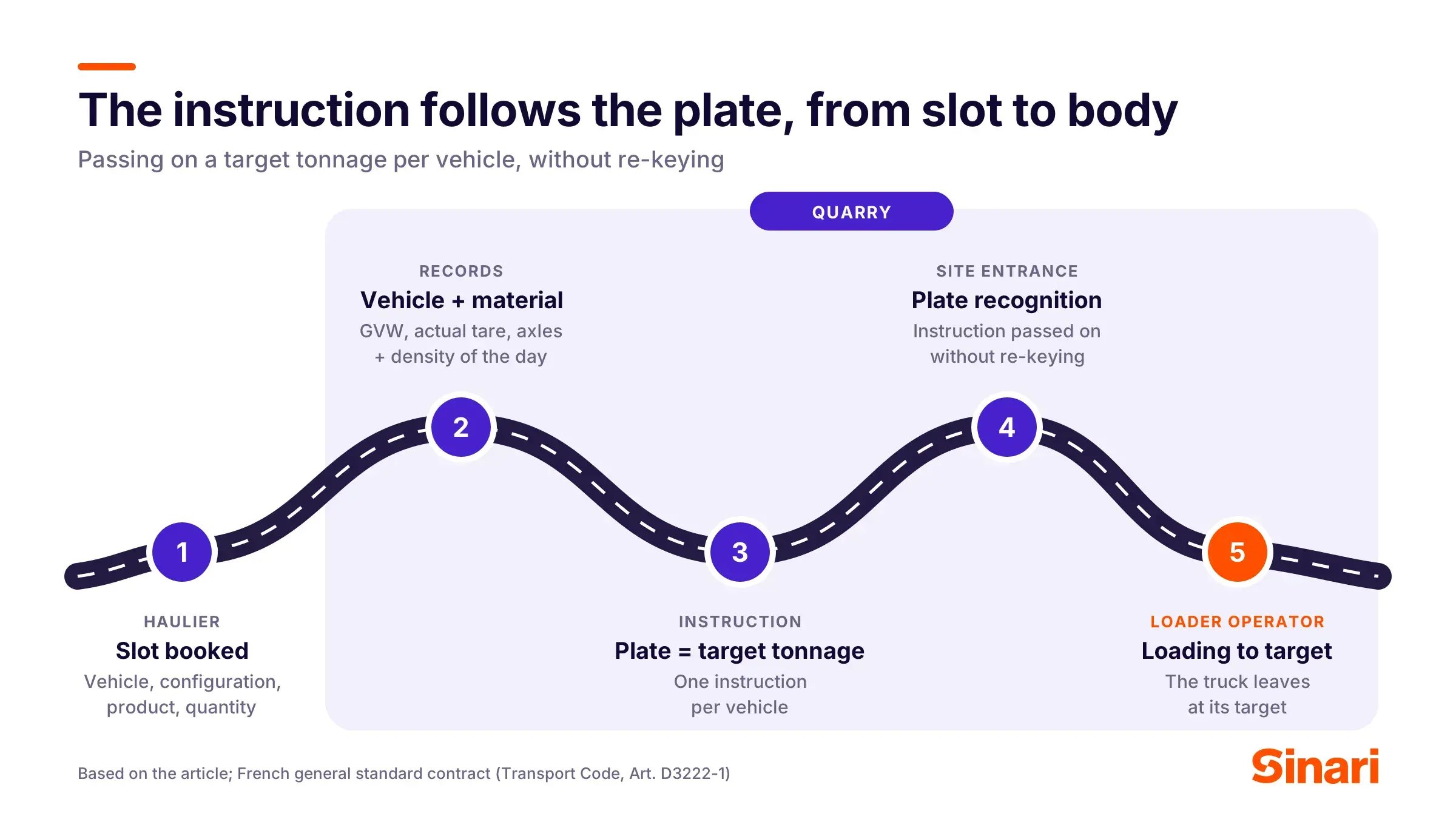
A loading instruction is transmitted as soon as a loading slot is requested, by associating a license plate with a target tonnage. The vehicle profile sets the limits: gross vehicle weight rating (GVWR), actual tare weight, and axle configuration. The material record specifies the conversion into loads: without the day’s density, the instruction remains an estimate. Upon arrival, license plate recognition transmits the instruction directly to the machine operator, without the need for re-entry or a stop at the counter.
The license plate is personal data, according to the CNIL: its automatic reading constitutes data processing that must be recorded in the quarry’s data processing register, as required by Article 30 of the GDPR. On every quarry-to-construction-site truck run, the truck arrives as expected and departs for its destination.
How can you prove that a delivery was made correctly to the construction site?
Compliant delivery is proven by a chain of documents, not by the driver’s word alone. The weigh ticket issued at the weighbridge certifies the load upon departure from the quarry. Signed upon arrival at the construction site, it serves as proof of a compliant delivery, which is useful in the event of an inspection or a dispute over tonnage. When signed electronically, this slip has the same legal weight as a paper document, according to Articles 1366 and 1367 of the Civil Code. The target load then becomes evidence shared by all parties.
What must a quarry weigh slip include?
The quarry weigh slip must unambiguously identify the weighing. It must include the date and time, the vehicle’s license plate number, the carrier, the customer, and the construction site, the product, the gross weight, the tare weight, the net weight, and the reference number of the weighing instrument used. Adding the vehicle’s target load makes the difference immediately apparent at a glance. In the event of an inspection, this document serves as proof of the load at departure, but it does not replace the weigh-in conducted by officials.
Its validity depends on the metrological verification of the weighbridge. A weighing instrument subject to legal metrology must be verified periodically and bear the mark of this verification, in accordance with Decree No. 2001-387. The electronic signature on the slip—first by the driver and then by the job site—is valid only if the weighing itself is reliable.
Why does software designed for quarries make a difference?
Software designed for quarries makes a difference because it is based on the industry’s specific constraints: materials sold by weight but loaded by volume, densities that vary with the weather, customer trucks with multiple configurations, and shared responsibility on the part of the loader. A general-purpose ERP system—a solution designed for all industries—manages orders and invoices, but not license plates, tare weights, or target loads.
Sinari Carsabe is quarry management software custom-designed for quarries and sand pits, according to Sinari. It integrates automated weigh tickets with license plate recognition, real-time inventory management, invoicing, electronic signatures, and job site scheduling. The quarry management software thus becomes the tool for coordinating operations between the quarry and the construction site: the same data is used for loading, documentation, and invoicing.
The target load: a common language between the quarry, the carrier, and the construction site
The target load is the common language that was previously missing between the quarry, the carrier, and the construction site. It is calculated based on the payload and bulk density. It is distributed in accordance with the axle load limits set forth in Articles R312-5 and R312-6 of the Highway Code. It is managed based on weigh-in results and the cost per metric ton delivered. Finally, it is documented via the time slot, delivery instructions, and weigh-in slip. The target load thus depends as much on quarry-to-construction-site coordination as it does on compliance.
The Highway Code sets the limits, but it is the quarry that must maintain them, load after load. For UNICEM member sites, as well as their FNTR or OTRE carriers—which are monitored by the DREAL—this means fewer load reductions, fewer lost metric tons, and solid evidence in the event of an inspection. Sinari Carsabe puts this data to work for the entire supply chain, from the scale to the invoice. Request a personalized demonstration of Sinari Carsabe to implement it at your site.