
Summarize this article with:
Sommaire
In the road haulage industry, securing loads is not just a question of regulatory compliance: it's a real operational challenge that has a direct impact on profitability, customer satisfaction and crew safety. And yet, despite the training and standards in force, incidents linked to poorly secured or ill-prepared loads remain frequent. For a transport operations manager, understanding the causes of these malfunctions and taking action upstream is essential.
Why are load-related incidents still frequent?
In the field, incidents linked to load securing are not uncommon. According to industry figures, around 25% of accidents involving HGVs are directly or indirectly linked to a loading problem (shifting of goods, strap breakage, poor wedging). These incidents have tangible and costly consequences for transport companies.
Loading in a hurry
The pressure of deadlines often forces teams to load quickly, without taking the time to check each securing point. The result: poorly tensioned straps, forgotten corner protectors, or fragile goods exposed to impact. In the express transport or e-commerce sectors, where loading windows are sometimes counted in minutes, this constant urgency multiplies the risks.
Poor anticipation of constraints
When operations fail to communicate specific loading requirements in advance, the field improvises. Incorrect weight distribution, underestimated volume, unsuitable vehicle type, incompatibility between several products on the same round: these are just some of the situations that undermine transport safety.
Lack of coordination between operations and the field
When information flows poorly between the office and drivers, errors multiply. A driver who discovers at the quay that he has to transport 1.20 m pallets, when his sheeted truck is equipped for standard 0.80 m pallets, is guaranteed to be late, and risk damaging his goods.
This desynchronization particularly affects fast-growing companies or those managing multi-customer flows with specific constraints (pharmaceuticals, high-tech, perishable goods).
Concrete consequences
These malfunctions generate measurable impacts:
- Damaged goods: crushed cartons, damaged products, pallets overturned during braking. In the pharmaceutical sector, a single overturned pallet can represent tens of thousands of euros in losses.
- Delivery delays: time wasted in emergency re-stacking, detours to secure the load. In the retail sector, a delay can result in refusal of delivery.
- Customer disputes: dissatisfaction, debit notes, loss of commercial contracts. Demanding customers (automotive industry, food industry) are less and less tolerant of errors.
- Risks for drivers: falls from height when securing loads, road accidents caused by shifting loads. Falls are the leading cause of occupational accidents in the road transport sector.
- Regulatory penalties: in the event of non-compliant securing, the driver and the company are liable to fines of up to 4th class, immobilization of the vehicle and significant indirect costs.
Stowage and securing: an essential lever in the field
To limit these incidents, we must not neglect the stowage and securing of goods. It's a performance lever in its own right, based on three fundamental pillars.
Personal safety first and foremost
A poorly secured load exposes drivers to the risk of serious accidents. Overhead securing operations, particularly on flatbeds and covered trucks, represent a permanent hazard. CNAMTS statistics show that falls from height are responsible for around a quarter of serious accidents in the transport sector.
The Multi-Stick multifunctional pole developed by L-EX is a good illustration of this concern: it enables straps and angles to be positioned from the ground, eliminating the risk of falls. This ergonomic tool radically transforms drivers' working conditions and reduces exposure to accidents.
Regulatory compliance
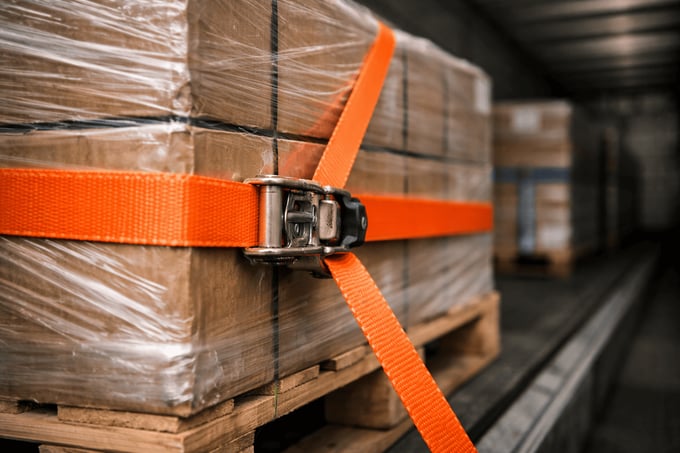
European regulation EN 12195-1 imposes precise standards on lashing. This standard defines safety requirements for lashing devices, force calculation methods and best practices to be respected. Using compliant tie-down straps, anti-slip mats and appropriate locking bars means protecting yourself against roadside checks and penalties.
At L-EX, all tie-down straps are certified compliant and can be customized to your needs:
- Standard 2000 daN straps with 50 mm ratchet tensioner
- 2500 daN ergonomic straps with reverse ratchet
- 2500 daN straps with Comfort Line handle for superior handling comfort
- Water-repellent straps for outdoor loads exposed to the elements
All these straps are available in different lengths (9 m standard or custom-made) and with your company's name printed on them, reinforcing your professional image in the field.
Protecting your goods
Beyond the safety aspect, proper securing preserves the integrity of the products transported. This is particularly critical in demanding sectors: pharmaceutical transport (shock-sensitive products), high-tech (fragile electronics), agri-food (risk of contamination), or e-commerce (customer packaging to be preserved).
Anti-slip mats are another strategic piece of equipment. By increasing the friction between the pallet and the vehicle floor, they reduce the number of anchoring points required and speed up loading operations. In some cases, they can even halve the number of straps required, generating significant time savings.
Anticipate loading operations right from the start, to make routes more reliable
Safe loading begins long before the loading dock. It's at the operational level that the quality of preparation and the limitation of last-minute improvisations come into play. This anticipation is all the more crucial in a context of tight deadlines, driver shortages and growing customer demands.
Better route preparation
When the operator has a clear vision of upcoming orders, he can anticipate the need for securing equipment: how many straps? What type of angles? Do I need anti-slip mats for this customer? Should locking bars be prepared for the refrigerated van?
This advance planning avoids trips to the store, delays in departure and situations where the driver has to improvise with unsuitable equipment. It also makes it possible to check the condition of the equipment (worn straps, faulty ratchets) and replace it before departure, rather than at the time of loading.
Anticipating vehicle and freight constraints
Knowing in advance the type of goods (fragile products, heavy loads, European pallets or special dimensions) and the type of vehicle assigned to them enables you to prepare loading in the best possible conditions. A flatbed truck is not loaded in the same way as a refrigerated van, and anticipating these differences drastically reduces errors.
Examples of specific constraints to anticipate:
- Pharmaceutical transport: respect for the cold chain, traceability, reinforced security against theft, etc.
- Hazardous products (ADR): stowage in compliance with ADR regulations, incompatibilities between products
- E-commerce: multiple parcels, urban deliveries, restricted access requiring an adapted vehicle
- Retail: filmed pallets, strict delivery schedules, rapid unloading required
Less improvisation on D-day
When operations communicate upstream with the field, drivers know exactly what to expect. He arrives at the dock with the right equipment, knows the customer's constraints (delivery times, difficult access, type of unloading) and can concentrate on securing the load rather than managing the unexpected.
This preparation also improves customer relations: an informed, well-equipped driver inspires confidence and professionalism. Conversely, a driver who discovers constraints at the last minute conveys an image of disorganization, even if the service is ultimately provided.
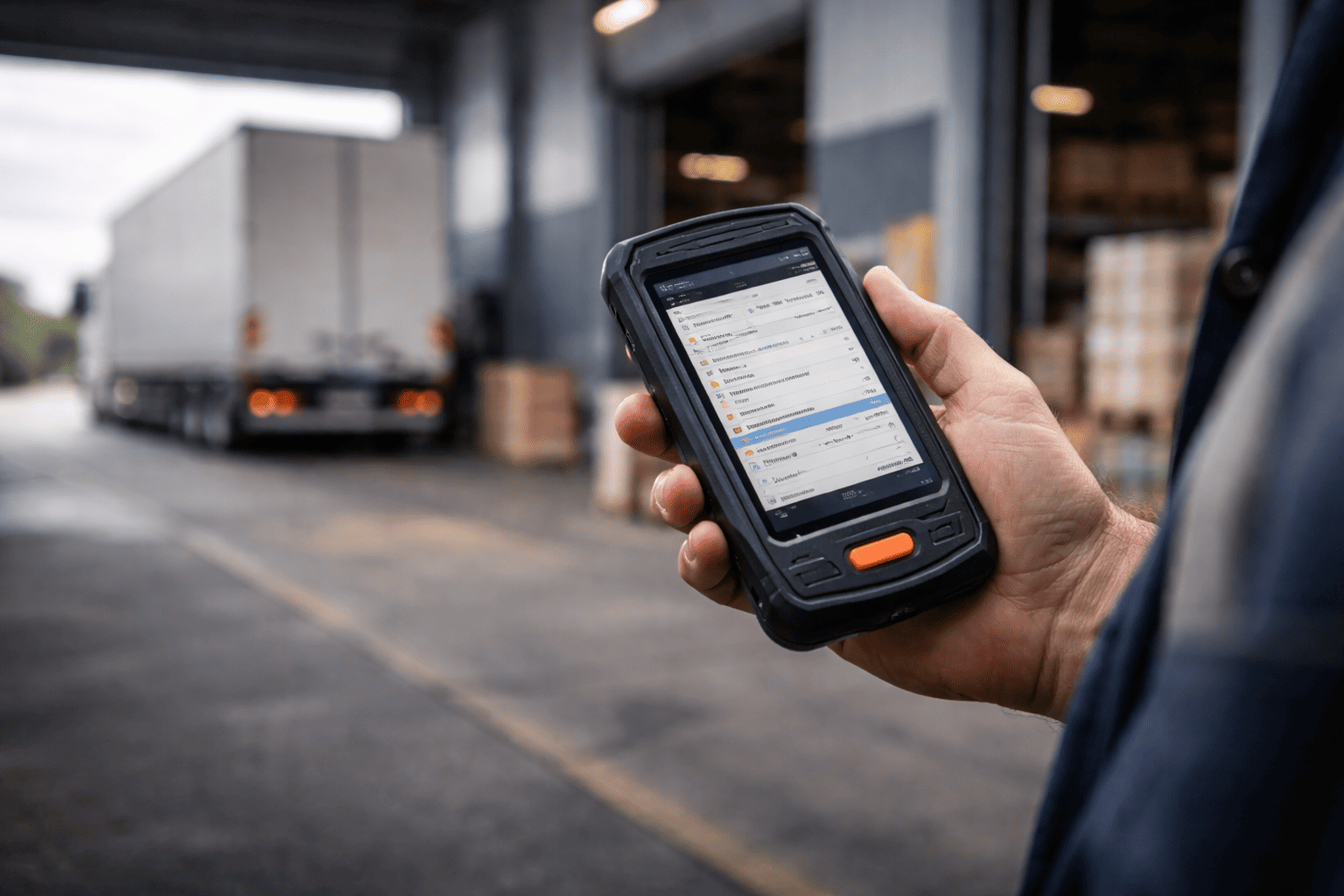
To structure this preparation and make operations more reliable, some transporters rely on transport management tools, such as Sinari TMS, to anticipate constraints and better coordinate teams. These solutions automate route planning, manage available resources (vehicles, drivers, equipment), centralize customer information and track the progress of operations in real time, thus reducing errors and downtime.
Conclusion
For transport operations managers, securing loads is not just a matter of providing drivers with straps and angle irons. It's a subject that requires a global vision: anticipating constraints, coordinating teams, equipping with compliant equipment and training the field in best practices.
FAQ : Securing loads
What is the lifespan of a lashing strap?
The lifespan of a lashing strap depends on how it is used and maintained. With intensive daily use, a strap can last between 1 and 3 years. It is recommended to regularly check the condition of the straps (wear and tear on the textile strap, ratchet operation, condition of the hooks) and replace them at the first signs of deterioration. Straps should be stored away from moisture and UV rays to extend their lifespan.
How can I tell if my stowage complies with regulations?
A load is secured correctly when it complies with the principles of standard EN 12195-1 (securing forces, load distribution) and the requirements of the Highway Code regarding load safety. In practical terms, this means that the load must be secured in all directions (braking, acceleration, cornering), that the equipment used is certified (LC marking visible on the straps), and that the lashing methods are appropriate for the type of goods and vehicle.
What equipment is mandatory in a truck?
Regulations require a basic set of safety equipment (warning triangle, high-visibility vests, compliant fire extinguisher, etc.), as well as sufficient and appropriate securing of the goods being transported (certified straps, anchor points, and possibly protection for sharp edges). Specific equipment may be added depending on the circumstances (ADR equipment for hazardous products, ATP for perishable goods).
How many straps are needed to secure a pallet?
The number of straps depends on the weight of the pallet, the type of vehicle, and whether or not additional equipment (anti-slip mats, locking bars) is used. As a general rule, for a standard 800 kg pallet on a flatbed without anti-slip equipment, a minimum of 2 straps are required (1 lengthwise, 1 crosswise). The use of anti-slip mats can reduce this number. It is recommended that you receive training in methods for calculating the necessary securing force.






.webp)