

Sommaire
The road transport sector is entering a new phase of transformation. Between reductions in CO₂ emissions, the digitization of documents, reinforced social obligations and the energy transition, the regulations that will come into force between now and 2026 will profoundly alter the organization of transport companies.
For SMEs, which have more limited resources than large groups, these changes can seem complex, even discouraging. However, they also represent an opportunity to structure their processes, gain in competitiveness and meet the growing expectations of customers and principals, thanks in particular to tools like Sinari TMS that centralize and automate transport management.
So how do you anticipate these changes without coming under regulatory pressure? In this article, we decipher the 5 major priorities you need to prepare for today, using an educational, accessible and practical approach. The aim is to help you get ahead of the game, without waiting until the last few months to take action.
Something to remember right now: those who anticipate not only avoid the risk of sanctions, but also position themselves as reliable, modern partners to their customers.
CO₂ and eco-responsibility: what obligations will SMEs have in 2026?
Reducing the carbon footprint is at the heart of European priorities for road transport. By 2030, the European Union is imposing a 55% reduction in CO₂ emissions from heavy goods vehicles compared with 2019 levels. This trajectory translates into a series of obligations that will gradually apply from 20252026, and which directly concern SMEs.
What new regulatory requirements?
- Mandatory reporting of CO₂ emissions: since 2025, companies have to transmit reliable data on their fuel consumption and carbon footprint.
- Low-emission zones (ZFE): several metropolises will extend their restricted traffic perimeters, directly impacting hauliers whose fleets are still predominantly combustion-powered.
- European reduction targets: the EU is putting pressure on manufacturers and, indirectly, on hauliers to adopt less-polluting vehicles.
- Possible local eco-taxes: some regions are planning to increase ecological taxation on road transport.
What are the risks for latecomers?
Companies that fail to anticipate these changes run the risk of :
- financial penalties (non-compliance with declarations or restricted access to EPZs) ;
- a loss of competitiveness in the face of competitors already committed to the transition;
- a risk of exclusion from certain markets, particularly those where principals require reliable CO₂ reporting.
How can we prepare for this in concrete terms?
To anticipate calmly:
- Set up a CO₂ tracking system: modern TMSs now incorporate automated emissions calculation modules.
- Plan fleet renewal: identify priority vehicles to replace older models with Euro 6, electric or CNG versions.
- Train teams: educating operators and drivers in eco-driving can reduce fuel consumption by up to 10%.
- Anticipate the impact of EPZs: map activity zones and adapt routes or resources.
- Prepare CO₂ reporting in line with principals' expectations.
eFTI and eCMR: how will the digitization of documents transform the daily lives of SMEs?
The dematerialization of transport documents is no longer an option: it is gradually becoming the norm, driven by European regulations and the quest for competitiveness. Two key systems are at the heart of this transformation: eFTI and eCMR.
What is eFTI?
eFTI(Electronic Freight Transport Information) is a European regulation that will come into force progressively from 2026.
Its aim: to impose a standardized platform enabling companies to share transport-related information electronically with the relevant authorities.
In concrete terms, this means :
- direct digital access by authorities (customs, road control, etc.) to carrier information;
- a gradual end to paperwork during inspections;
- European harmonization to simplify exchanges between member states.
What's different about eCMR?
The eCMR is the digital version of the international consignment note (CMR). Already adopted by some thirty European countries, eCMR makes it possible to :
- replace the paper document with a legally recognized dematerialized version;
- reduce printing, archiving and dispute management costs;
- streamline exchanges between carriers, shippers and authorities.
For SMEs, eCMR saves considerable operational time: fewer administrative tasks, fewer data entry errors and improved traceability.
What are the concrete benefits for SMEs?
Although at first sight these new obligations may seem restrictive, in reality they open the way to numerous operational gains. The dematerialization of documents can significantly reduce administrative costs, with up to 30% time saved on document management. By centralizing and time-stamping information, it also limits disputes and simplifies the resolution of disagreements.
Another key benefit is that digital transmission speeds up invoicing cycles, enabling companies to improve their cash flow. Controls are also made easier: authorities can access documents in just a few clicks, with no loss of time. Finally, this modernization enhances the image of SMEs in the eyes of their customers and principals, who are increasingly attentive to the traceability and responsiveness of their partners.
How to anticipate implementation?
To tackle this transformation calmly, it is in the best interests of SMEs to equip themselves with a TMS compatible with eFTI and eCMR, in order to centralize their data and automate document transmission. The training of administrative teams and operators is also a key step in ensuring smooth adoption of the new tools.
Rather than making a sudden changeover, it is advisable to test dematerialization gradually, for example on a panel of customers or on certain regular routes. Last but not least, collaborating with authorities and logistics partners upstream helps to ensure that processes are compliant, and to avoid unpleasant surprises at the time of roll-out.
How can we anticipate the arrival of 2nd generation tachographs and their social impact?
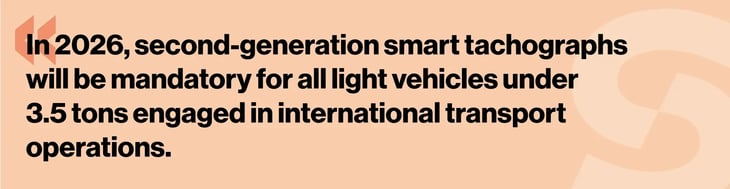
From July 1, 2026, 2nd generation intelligent tachographs will be mandatory for all light vehicles under 3.5 tons used for international transport operations. This regulatory change, which stems from the Mobility Package, not only concerns equipment, but also profoundly modifies the social management of drivers.
What is the regulatory framework?
- Key deadline: July 1, 2026 for vehicles < 3.5 t (international transport).
- Data downloading and archiving: tachograph data must be retrieved every 28 days.
- Increased checks by the authorities (including for light vehicles).
- Employer liability for non-compliance with driving and rest times.
What are the implications for SMEs?
For small and medium-sized businesses, the arrival of 2ᵉ generation intelligent tachographs represents a real turning point in social and operational management. This new requirement means that HR processes are becoming increasingly complex, with a growing volume of data to be collected, analyzed and archived. It also brings with it an increased risk of fines in the event of late uploading of data or exceeding authorized driving times.
Operators will also have to deal with a greater administrative burden, as they will have to integrate this information into their day-to-day monitoring tools. Last but not least, team training is essential: understanding and correctly applying the new rules is the only way to avoid penalties.
Without anticipation, the cost of a fine for non-compliance with the tachograph can quickly exceed several thousand euros per vehicle... a risk that few SMEs can afford.
What actions should be taken now?
To prepare effectively and limit the risks, it is in the best interests of SMEs to adopt a gradual approach. The first step is to equip the vehicles concerned today, rather than waiting for the 2026 deadline. At the same time, the implementation of an integrated social management solution, capable of generating automatic alerts when driving times are exceeded, greatly facilitates day-to-day monitoring.
It is also crucial to upgrade the skills of operators and HR managers: appropriate training will enable them to master the new tools and ensure that practices are compliant. Last but not least, planning regular internal audits enables us to check that procedures are being respected, and to quickly adjust any deviations.
How can the energy transition become an opportunity for transport SMEs?
The energy transition in the road haulage sector is no longer just a trend: it has become a legal and economic obligation. Between the Loi d'Orientation des Mobilités (LOM), the deployment of infrastructures and the financial aid available, SMEs can turn this constraint into a competitive lever.
What is the regulatory context?
- Loi d'Orientation des Mobilités (LOM): imposes progressive quotas on the acquisition of clean vehicles for certain transport operators.
- Deployment of recharging infrastructures: thanks to the France Relance and AFIR (Alternative Fuels Infrastructure Regulation) plans, recharging points for electric and CNG vehicles are multiplying.
- European targets: 55% reduction in CO₂ emissions by 2030, implying a rapid transformation of the vehicle fleet.
What opportunities are there for SMEs?
The energy transition offers concrete benefits for transport companies:
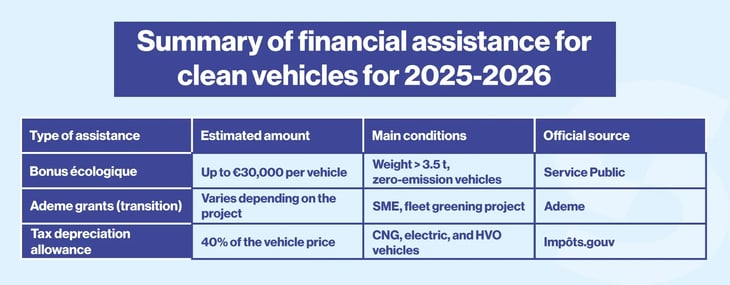
- Attractive financial aid: Ademe subsidies, ecological bonuses, additional depreciation for the acquisition of clean vehicles.
- Lower operating costs: differentiated tolls, tax exemptions, long-term fuel savings.
- Added value for shippers: major clients are increasingly favoring transporters with an ecological commitment.
What roadmap to adopt?
To tackle this transition without unbalancing their budgets, SMEs can :
- Carry out a diagnosis of their current fleet: identify the vehicles to be renewed as a priority.
- Evaluate the feasibility of an energy mix (diesel, electric, CNG, HVO) according to their routes and customers.
- Gradually deploy clean vehicles, aiming for 5 to 10% integration by 2026, for example.
- Plan ahead for the necessary infrastructure: in-house charging stations or partnerships with public stations.
How is intermodality reshaping market constraints for transport SMEs?
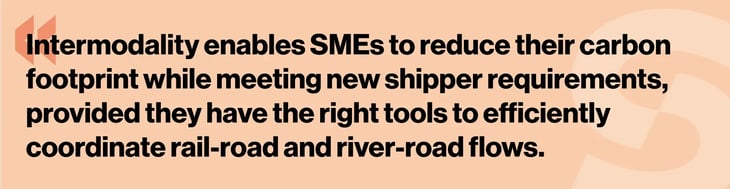
In the face of regulatory pressure and growing demand from shippers, intermodality (the combination of several modes of transport: road, rail and waterway) is emerging as an essential solution. However, for SMEs in the road haulage sector, intermodality represents both a challenge and a strategic opportunity.
What regulatory changes are expected?
- European directive on combined transport: aims to encourage the use of rail and river transport to reduce the share of long-distance road haulage.
- Eurovignette CO₂: gradual introduction of a pricing system incorporating CO₂ emissions into the cost of HGV tolls, encouraging hauliers to optimize their flows and consider multimodal solutions.
- Tax incentives: some European countries are already introducing tax breaks for companies using road-rail.
What's at stake for SMEs?
Intermodality is profoundly transforming road transport habits, and its impact is already being felt by SMEs. Demand from shippers is evolving rapidly: more and more principals are looking for partners capable of offering low-emission transport solutions, integrating rail, road or river. This environmental requirement is becoming a decisive criterion for winning certain contracts.
But this development is also accompanied by increased administrative complexity. Between managing customs documents, eFTI exchanges, coordinating connections and strictly adhering to deadlines, operators have to demonstrate a new rigor in their day-to-day organization.
Finally, companies that adapt upstream to these new models gain a real competitive advantage. By gradually integrating intermodal solutions into their offerings, they boost their competitiveness, win the loyalty of their most carbon-conscious customers, and position themselves as responsible, innovative players in the transport of tomorrow.
Which solutions to consider?
To gradually integrate intermodality without disrupting their operations, SMEs can :
- Equip themselves with a rail-road/river-road compatible TMS, to centralize operations and reduce the risk of errors.
- Forge strategic partnerships with multimodal operators to pool costs and simplify flow management.
- Train their operators in the specificities of intermodal planning (scheduling constraints, logistics platforms, digital tools).
- Anticipate contractual constraints imposed by certain shippers to avoid penalties.
How can SMEs effectively anticipate 2026 obligations?
The accumulation of new regulations (CO₂, tachographs, intermodality) can seem overwhelming for small and medium-sized transport companies. However, by structuring their approach, they can prepare calmly while avoiding the extra costs associated with late compliance.
1. Conduct an internal regulatory audit
Before investing or modifying their organization, SMEs need to take stock of the situation:
- CO₂ compliance: check reporting capabilities and available monitoring tools.
- Document digitization: eCMR, eFTI preparation.
- Tachographs and social management: downloading, archiving, legal alerts.
- HR organization: raising awareness of legal obligations among operators and social managers.
Tip: this audit can be carried out in-house or by a specialized partner.
2. Prioritize critical actions
Not all obligations are equal in terms of risk:
- CO₂ and tachographs: direct impact on finances (fines, penalties, loss of contracts).
- Document digitization (eCMR, eFTI): administrative optimization and anticipation of future obligations.
- Energy transition and intermodality: strategic approaches to be gradually integrated.
Recommendation: concentrate efforts on high-risk actions first, before planning longer-term projects.
3. Draw up a budgeted action plan 2025/2026
A clear roadmap helps keep investments under control:
- Purchase of an adapted TMS.
- Training for operators and HR/social managers.
- Possible integration of clean vehicles (as part of LOM quotas).
- Implementation of automated regulatory monitoring tools.
For example: integrating a TMS that manages tachograph alerts and CO₂ tracking can reduce the time spent on compliance tasks by 30%.
4. Track progress with simple KPIs
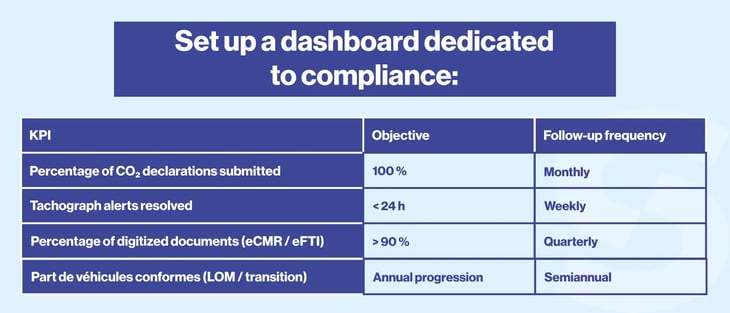
To monitor your progress and measure the effectiveness of your action plan, it's essential to define simple, concrete indicators. These transport KPIs will enable you to monitor your compliance and performance on a daily basis.
Conclusion: why anticipate 2026 today?
2026 will be a pivotal year for road transport SMEs:
- Mandatory CO₂ declarations,
- 2nd generation tachographs imposed on light vehicles,
- Growing pressure on energy transition and intermodality.
By delaying compliance, many companies risk not only fines, but also a loss of competitiveness in the face of carriers already equipped.
Anticipating now means turning these constraints into opportunities: automating compliance, simplifying social monitoring, and optimizing operating costs.
.webp)
.webp)
.webp)

.webp)
.webp)