
Sommaire
In France, as in Europe, transport companies have to deal with an increasingly complex equation: steadily rising fuel and wage costs, inflation in maintenance costs, a shortage of drivers and increased regulatory pressure (road safety, reduction of CO2 emissions, RGPD). In this context, every kilometer, every hour of production and every liter of fuel counts.
On-board telematics, and more broadly fleet telematics, have established themselves as an essential technology and management solution for locating vehicles in real time, measuring fuel consumption and carrying out behavioral analyses. However, in many companies, its potential remains largely under-exploited: it is often limited to GPS or eco-driving monitoring, without being linked to the strategic issues of operations and profitability.
However, when used properly, on-board telematics applied to fleet management becomes a complete management tool, and a veritable cockpit for rational and financial opé: optimizing resources and routes, reducing fuel consumption, predictive maintenance, improving safety, complying with regulations, energy efficiency and reducing environmental impact... all measurable levers and concrete benefits for all types of HGV fleets, especially when based on an integrated solution like Sinari Telematics.
In this article, we'll look at how to go beyond the simple definition of GPS to make telematics a performance gas pedal for operators, fleet managers, maintenance managers and executives.
What is fleet management via on-board telematics?
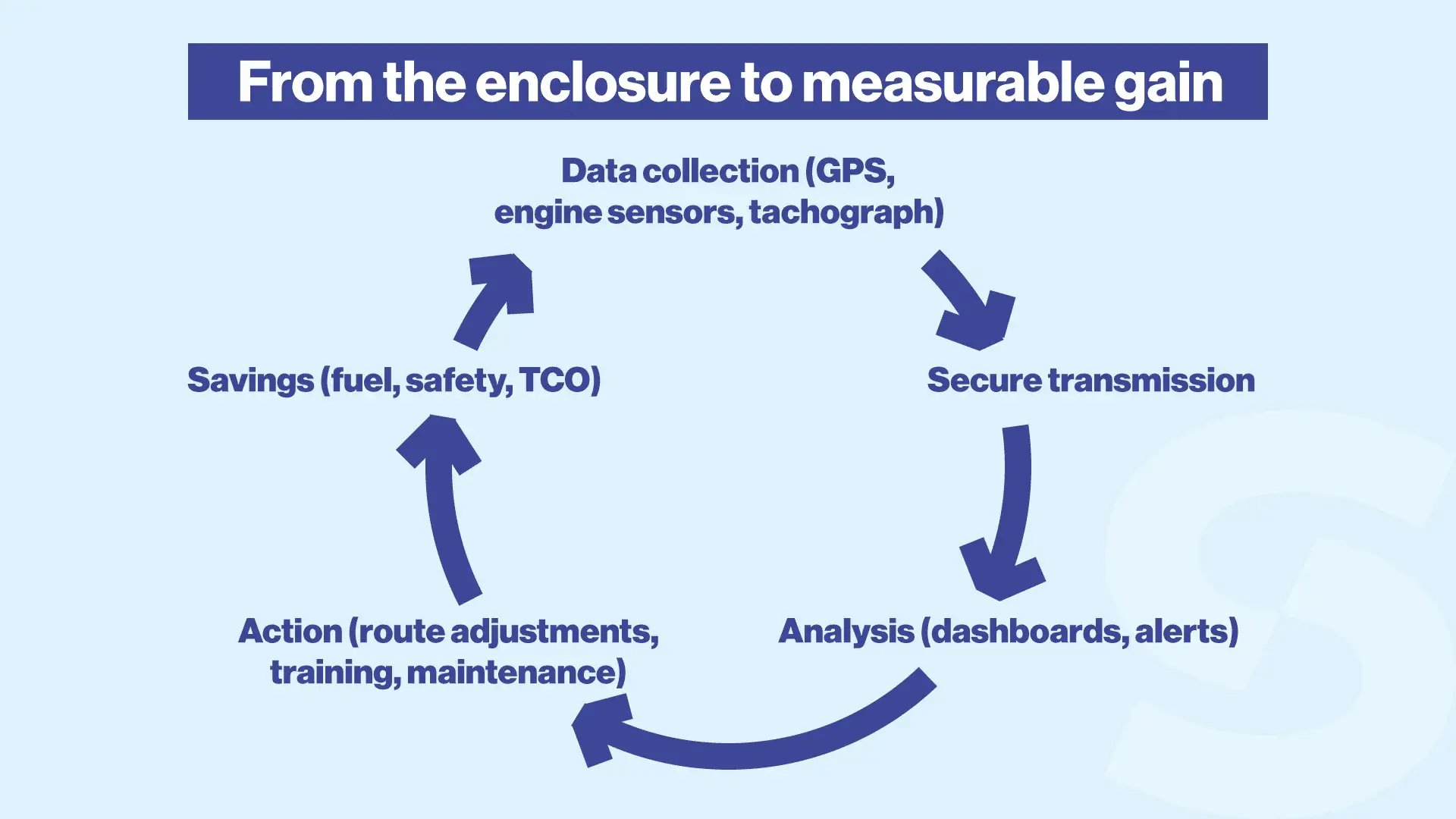
Telematics-based fleet management is based on a combination of three key elements:
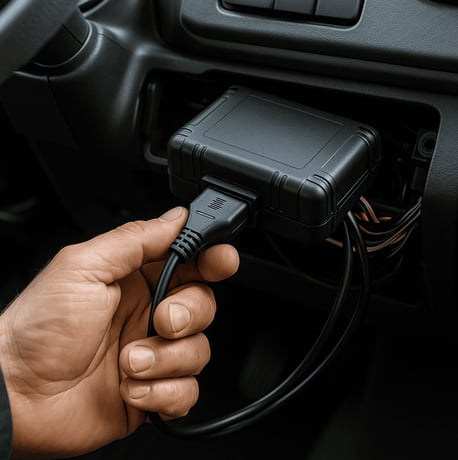
A connected box installed on each vehicle (truck, van, machine)
- GPS for real-time positioning via a geolocation system
- CAN BUS FMS interface for technical data collection with additional sensors to measure other key parameters (stands, tiller arms, tarpaulins). Allows measurement of: fuel consumption, engine speed (RPM), acceleration, braking, dashboard warning lights, with a particular focus on anticipation and inertia, enabling analysis of driving behavior and thus impacting on fuel consumption and driving risks)...
- Direct interface with the digital tachograph to collect social data in real time, as well as legal data (C1B, V1B files).
Secure transmission
- Data sent continuously to a secure communication HUB via the cellular network (3G, 4G)
- RGPD-compliant secure protocols (encryption, anonymization, right to be forgotten)
A central management platform
- Accessible to fleet operators and managers via a web application or a management platform also accessible on smartphone.
- Real-time alerts and consolidated reports
- Integration with TMS or ERP (e.g. Global Solution: Sinari Telematics + Sinari TMS), but also with workshop solutions such as Sinari FMS, to ensure linkage and communication between operations, human resources, invoicing and maintenance services within an integrated management system.
From GPS to a strategic tool
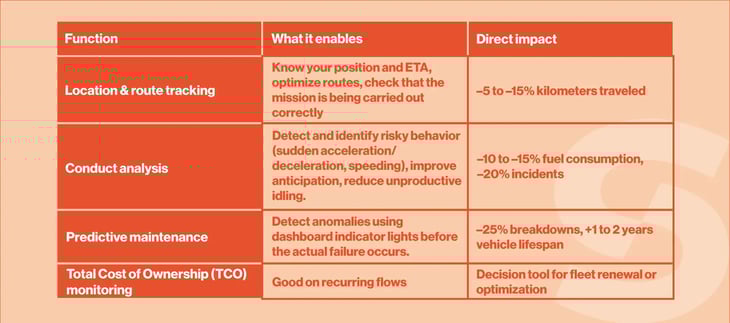
While GPS is often the most visible element, the real value of on-board telematics comes from data centralization and analysis:
Key figures (France/Europe)
- 31% of European fleets use telematics on more than 75% of their vehicles (Frost & Sullivan)
- Up to 20% improvement in fuel consumption and 15% reduction in carbon footprint with a properly deployed system
- Up to 30% reduction in accidents through driver monitoring and coaching
In a nutshell
A modern telematics system goes beyond simple vehicle tracking. It becomes a strategic software platform that centralizes and analyzes data to optimize management and provide a precise status of your fleet, directly linked to business needs such as efficient fleet and truck workshop management.
The 3 pillars of major impact of on-board telematics in fleet management
Cost reduction
One of the benefits of a high-performance tracking system is the ability to control the most costly items. By analyzing the data generated by the tracking system, it is possible to track down invisible losses and turn micro-gains into substantial savings. Examples of possible actions:
- Continuous monitoring of consumption to identify bad behavior, abrupt acceleration/deceleration or over-revving, reducing engine use at unproductive idle.
- Reduce empty mileage by selecting the right means of transport and optimizing routes.
- Predictive maintenance to quickly identify anomalies (fault codes, engine faults) before a breakdown immobilizes the vehicle.
Key figures: up to -15% in fuel consumption, -25% in breakdowns, and -10% in maintenance costs.
Safety & compliance
Transport companies know that safety is a strategic issue: it protects the integrity of drivers and vehicles, and preserves profitability by reducing the cost of claims. Telematics solutions enable proactive management of road safety, with the integration of on-board camera systems (DASHCAM):
- Driving behavior analysis: easily identify drivers with potential for improvement, thanks to indicators on anticipation (absence of sudden acceleration and braking, etc.), inertia (making the most of the vehicle's kinetic energy), excessive speeds (in line with regulations and on bends).
- Proactive communication through alerts and driver scoring
- Geolocation in the event of theft.
- Monitoring compliance with European social regulations and labor laws.
- Compliance with legal data collection deadlines (C1B, V1B files).
The data speaks for itself: coaching based on real data = -30% accidents, 15% reduction in the severity of claims, enhanced traceability to limit legal risks.
Operational performance
A well-configured software platform or management software becomes an ally in optimizing management and providing total visibility of activity.
For example:
- Real-time optimization of itineraries with traffic information and specific constraints.
- KPI-based management: fleet utilization rate, road time/stop ratio, productivity per tour.
- HR commitment: internal challenges, monitoring and target-based bonuses.
- Service quality: Compliance with loading/unloading appointment commitments, ETA calculation, automatic alerts in the event of delays, POD (Proof Of Delivery) with Mobility solutions.
Measured impact: up to +15% productivity with dynamic planning, -30 min per round thanks to optimized route calculation and +12 to 20% adherence to delivery schedules.
Key features to deploy
Implementing on-board telematics for fleet management is more than just tracking a vehicle on a map. The most effective solutions offer a true digital cockpit capable of controlling costs, safety and operational performance.
TCO dashboard - The big picture
A TCO (Total Cost of Ownership) dashboard provides a real-time overview of :
- Fuel consumption per vehicle or per driver
- Direct costs (maintenance, fuel, tolls)
- Indirect costs (downtime, incidents, claims)
A concrete example: a haulier who deployed the Sinari Telematics solution on a perimeter of 50 trucks identified real gains in fuel consumption (on the order of 10 to 12%), savings in administrative time thanks to real-time data feedback, and the assurance of having legal files within the allotted time. The time devoted to drivers is time for discussion, without having to ask "where are you, where are you? The implementation of a challenge with win/win objectives for both the company and the drivers has been a real success.
Connected telematics box for real-time data collection
Thanks to DTCs and automated mileage tracking :
- interventions are planned before breakdowns occur
- downtime is reduced by 20-25%.
- Combined with predictive maintenance, maintenance costs and average vehicle life are optimized.
ROI tip: Every euro invested in preventive maintenance saves up to 4 euros in unplanned repairs (source: Frost & Sullivan).
Real-time alerts and scoring - Driving control
A scoring system, based on anticipation (short stops due to lack of anticipation, measurement of braking and acceleration or inertia (making the most of the vehicle's kinetic energy), enables :
- identify risky behavior
- support drivers with a personalized coaching program
- set up internal challenges to engage drivers
Compliance with regulations
For truck fleets subject to CSR and labor code compliance:
- Real-time collection of social data, display of remaining production time for drivers and operators
- C1B and V1B data collection and archiving in compliance with legal obligations
- RGPD-compliant data management (anonymization, right to be forgotten, access traceability)
To sum up: a good on-board telematics solution isn't just about tracking. It's a global management tool that links economic performance, safety and compliance on a single interface.
Deployment: a simple, structured, business-focused approach
Deploying an on-board telematics solution involves much more than simply installing boxes. Feedback from the field (INRS, SIE deployment studies) shows that success rests on three pillars: preparation, support and gradual integration.
Clarify objectives and involve teams
Before any installation, you need to define what you want to improve: consumption, safety, TCO, social compliance...
This step aligns management, operations and maintenance, avoids overly broad rollouts and prepares the ground for change management.
Choose an integrated solution to avoid double entry
The main risk observed in ill-prepared deployments is the cohabitation of old tools and new systems.
➡ This leads to work overload, loss of information and internal tensions.
With Sinari Telematics, natively interconnected with the TMS and FMS, we avoid these drifts right from the start of the project.
Training and getting teams on board
Success depends on the commitment of those who use the tool: drivers, operators, fleet managers.
INRS studies show that :
- too frequent communication can disrupt driving,
- incorrect configuration generates stress and an overload of alerts,
- appropriate teaching methods reduce resistance.
➡Simple workshops, clear instructions and a "tool to help, not control" stance encourage adoption.
Adjust during the stabilization period
The first 2-3 months always generate a fine-tuning phase.
You need to :
- analyze data,
- adjust alerts,
- simplify reports,
- avoid too many indicators.
➡ Objective: make the tool truly useful, without information overload for operations.
Integrate telematics into business processes
Once stabilized, the system becomes a business lever:
- route optimization,
- predictive maintenance,
- automated social monitoring,
- consolidated TCO dashboards.
The gradual elimination of old tools avoids duplication and secures gains.
Conclusion
On-board telematics applied to fleet management is no longer a simple tracking tool: it's a real control center with high added value, helping to optimize costs, improve safety, extend vehicle life and enhance customer satisfaction.
By relying on reliable, usable data, operators, maintenance managers and executives can move from reactive management to proactive, strategic steering. The benefits are measurable:
- -10% average fuel consumption / up to -10% fuel savings
- -15% in maintenance costs
- -30% fewer accidents
- +1 to 2 years vehicle life
At Sinari, we integrate telematics directly into our business solutions via Sinari Telematics, to offer a 360° vision of your fleet, connect real-time data to your TMS, and transform every piece of information into a lever for operational and financial efficiency.
.webp)
.webp)
.webp)

.webp)
.webp)