
Summarize this article with:
Sommaire
Digital tachograph: a complex word for an electronic device that has become an indispensable part of hauliers' daily lives. For several years now, it has been compulsory in all goods vehicles over 3.5 tonnes circulating in the European Union (with some exceptions). Its role? To accurately record drivers' driving and resting times, in order to ensure compliance with European social regulations, and more specifically with EEC regulations.
But beyond simple recording, the tachograph is a multifunctional device, a real lever for compliance, HR management, fleet management and operational efficiency. But it's important to understand it, use it correctly... and avoid certain common pitfalls, particularly those associated with manual data entry.
In this article, we offer you a complete overview :
- how the digital tachograph works and its legal obligations,
- the risks associated with poor data management,
- and, above all, the best practices to adopt, thanks in particular to new-generation on-board computing tools.
What is a digital tachograph?
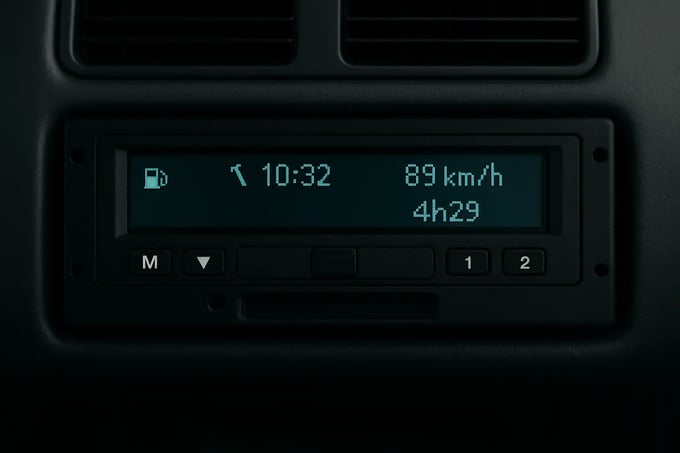
The digital tachograph is an electronic device installed on board heavy goods vehicles, designed to automatically record the driving, rest and activity times of truck drivers. It is gradually replacing the old analog tachograph with paper disc, still present in some older vehicles.
Since 2006, all vehicles over 3.5 tonnes registered in the European Union must be fitted with this system. With the entry into force of the Mobility Package, this obligation has been extended to other vehicle categories, notably for international transport.
The digital tachograph is based on two key elements:
- an on-board unit, integrated into the vehicle, which records driving data ;
- a driver card, inserted into the unit by the driver to identify his or her individual activity, via a card reader.
It is essential to note that the tachograph is a device which plays a major role in road safety and the prevention of driver fatigue. What's more, the data recorded (the so-called social data) can be used by operations to optimize routes, monitor driver performance, prepare payroll, or ensure better data analysis.
What the regulations say about the digital tachograph
The regulatory framework surrounding the digital tachograph is strict. It is designed to ensure compliance with European rules on driving, resting and working times for drivers of road transport vehicles.
Vehicles concerned
Use of the digital tachograph is compulsory for all goods vehicles over 3.5 tonnes travelling for professional purposes in the European Union. The Mobility Package has extended this obligation to certain light commercial vehicles used for international services, from July 2026.
Data download frequency
To remain compliant, operations must :
- remotely download driver card data no more frequently than every 28 days,
- download vehicle data (V1B file) every 90 days maximum.
These files (C1B for the card, V1B for the vehicle) come from a digital tachograph and contain essential legal data. They can be checked at any time by control bodies, whether on the road or during an in-house audit. Good organization of the reading of these files greatly facilitates control management.
Retention period
Transport companies must ensure that tachograph data is stored for at least one year, sometimes longer in the case of specific obligations (social, legal, etc.).
In the event of non-compliance
In the event of omission, incorrect manual data entry, or lack of proof in the event of an inspection, the company is liable to :
- administrative and criminal fines,
- sanctions in the event of a social audit or DREAL inspection,
- liability in the event of an accident involving non-compliance with daily rest periods or working hours.
The limits of manual tachograph data management
Although digital tachographs enable precise, regulatory data collection, manual data management is still widespread in many companies. However, this practice has many limitations, and even risks, for operations.
A waste of time for operations and drivers
Downloading tachograph data via USB key or mobile terminal means that teams have to intervene physically on each vehicle, often at inconvenient times: back at the depot, end of tour, etc.
Drivers sometimes have to interrupt their work just for this task, while operations have to mobilize resources to collect, archive and check the files.
High risk of oversight or error
Manual management relies on regular human intervention. This considerably increases the risk of :
- forgetting to download a file on time ;
- misnaming or misclassifying files ;
- or losing data in the event of media failure.
A simple oversight can result in legal non-compliance, even if drivers respect driving times.
Limited visibility of actual activity
Manual management does not provide a real-time view of driver or fleet activity. Data is only consulted after downloading, which limits the ability to :
- react quickly when thresholds are exceeded ;
- optimize routes according to the time available ;
- or correct an error before it becomes a dispute.
Why automate digital tachograph data collection?
Automating tachograph data collection is now a best practice for road hauliers. Thanks to on-board computing and connected solutions, it is now possible to retrieve legal files remotely, without any manual action.
Immediate time savings
Connected solutions automatically download C1B and V1B files remotely, according to a defined schedule (every 28 or 90 days).
No need to plug in a key or schedule a tour at the depot: data is transmitted in real time to the farm or a secure server.
👉 The result: fewer time-consuming operations for teams, and greater fluidity in the management of legal obligations.
Enhanced compliance
By automating data recovery, you drastically reduce the risk of :
- forgotten downloads
- misfiling,
- or missing files in the event of an audit.
Files are automatically stored in the right format, and easily accessible at any time for auditing or unannounced checks.
Synchronization with business tools
The data collected can be directly integrated into TMS or payroll software, facilitating :
- tracking driving and resting hours,
- optimized route planning,
- calculating hours worked for payroll purposes.
Improved data traceability
All operations are tracked and logged. You keep proof of downloading, with date, time and driver or vehicle ID. This ensures greater legal security of data in the event of a dispute.
The benefits of intelligent use of digital tachograph data
Automating the collection of digital tachograph data is a first step. But to take full advantage of this information, it needs to be used intelligently. Coupled with an on-board IT solution, this data becomes a real performance lever for operations.
Real-time route optimization
Driving data transmitted in real time can be used to adjust schedules during the day. Operations know exactly :
- how long a driver can drive today,
- whether he is due to take a break soon, or to finish his day,
- which route is the most appropriate given the time remaining.
This means that every hour of driving can be optimized in compliance with legal regulations, while improving the profitability of routes.
Tracking performance indicators
By centralizing data in TMS software, you can :
- analyze deviations in driving or rest times,
- detect recurrent delays or idle times,
- cross-reference tachograph data with business indicators (disputes, consumption, delays, etc.).
👉 This makes it possible to monitor performance driver by driver, and quickly identify areas for improvement.
🎓 Driver training and support
Analysis of driving times and infringements helps identify training needs: driving too hard, failure to respect breaks, poor schedule management...
This is an invaluable HR lever to help drivers adopt better practices, improve their working conditions and enhance safety.
Sinari Telematics: a complete solution for automating digital tachograph management
With Sinari Telematics, digital tachograph management becomes simple, fluid and compliant. Our on-board IT solution enables you to centralize all regulatory data, exploit it in real time and streamline your day-to-day operations.
Automatic download of C1B and V1B files
Sinari Telematics enables you to schedule the remote emptying of driver cards and central units, according to the frequency imposed by regulations. Files are automatically :
- downloaded,
- time-stamped
- archived,
- and available via a secure interface.
👉 No more delays, no more forgetting, no more stress in the run-up to an inspection.
Integration with TMS and HR tools
Data from the tachograph can be integrated in real time with your business tools:
- TMS for activity monitoring and route optimization,
- HR software for managing working hours, absences and payroll.
This synchronization saves you precious time and reduces the need for re-typing or human error.
Real-time data and automated alerts
Sinari Telematics gives you continuous access to :
- each driver's driving status (rest, work, availability, etc.),
- personalized alerts in the event of time overruns or violations,
- a global view to adjust schedules without delay.
A solution designed for road haulage
Designed for the demands of freight transport, our solution adapts to your fleet:
- light or heavy vehicles,
- single or multi-make,
- with an intuitive interface and personalized support.
In a nutshell: make the most of the digital tachograph
The digital tachograph is no longer just a compliance tool. Coupled with an on-board IT solution like Sinari Telematics, it becomes a real performance lever for hauliers.
By automating data collection, facilitating data processing via a TMS or HR tools, and offering real-time visibility of driving and rest times, you gain in :
- safety (compliance with regulations),
- efficiency (better route planning),
- productivity (less downtime, fewer errors),
- and even quality of life at work for your drivers.
.webp)

.webp)
.webp)

.webp)
.webp)